
Blog
Growth vs Profitability: Which Should Come First?
By the Rytmove Team · 20 Sept 2026
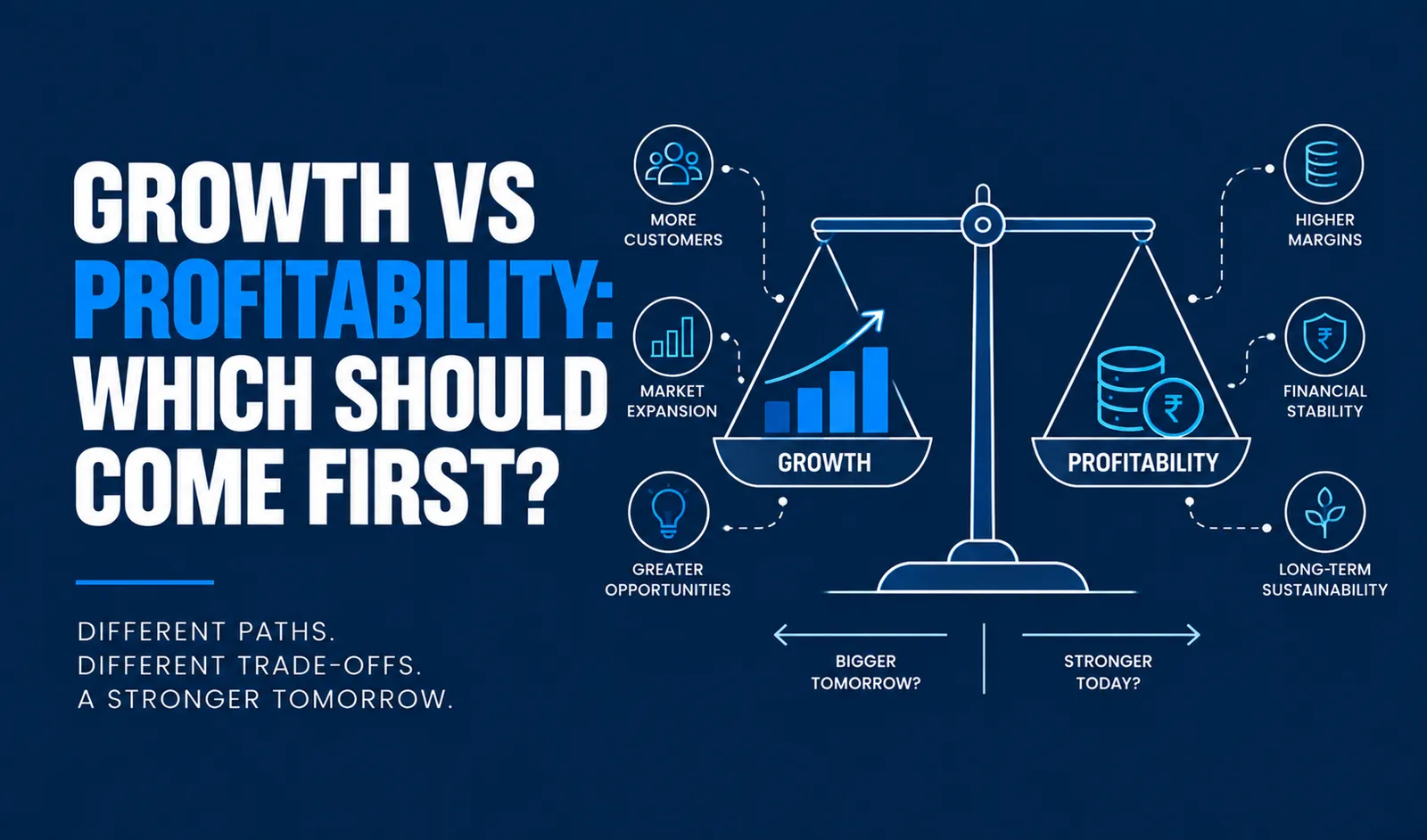
Almost every founder eventually faces the same question.
Should we focus on growth?
Or should we focus on profitability?
The debate has existed for decades.
Some of the world's fastest-growing companies prioritized growth for years before becoming profitable.
Others focused on profitability from the very beginning and built highly sustainable businesses.
Both approaches have produced successful outcomes.
Both approaches have also created spectacular failures.
The challenge is not choosing a universally correct answer.
The challenge is understanding which approach makes sense for your business.
Why This Question Matters
Resources are always limited.
Every rupee invested in growth cannot be used elsewhere.
Every effort to improve profitability may reduce short-term expansion.
Businesses constantly make trade-offs between:
Customer acquisition
Product development
Hiring
Marketing
Market expansion
Operational efficiency
The way these trade-offs are managed often determines the future trajectory of the company.
Understanding Growth
Growth focuses on increasing business size.
This can include:
Revenue growth
Customer growth
Market share growth
Geographic expansion
Product expansion
Team growth
Businesses prioritizing growth often reinvest most of their earnings back into the company.
The goal is simple:
Capture opportunity while it exists.
Understanding Profitability
Profitability focuses on generating sustainable financial returns.
A profitable business earns more than it spends.
Profitability provides:
Financial stability
Cash flow flexibility
Lower dependency on external funding
Greater resilience during downturns
Long-term sustainability
Profitable businesses often grow more cautiously but maintain stronger financial foundations.
The Case For Prioritizing Growth
Growth-first businesses often operate in markets where speed matters.
Examples include:
Technology platforms
Marketplaces
Network-effect businesses
Venture-backed startups
The logic is straightforward.
The company that captures customers first may become the market leader.
Benefits of prioritizing growth include:
Faster market penetration
Stronger brand awareness
Competitive advantages
Increased customer base
Potential market leadership
In some industries, slow growth can mean losing the opportunity entirely.
The Risks Of Prioritizing Growth
Growth is attractive.
But it can be dangerous when pursued blindly.
Common risks include:
High cash burn
Dependence on funding
Weak unit economics
Operational complexity
Reduced profitability
Many businesses grow revenue while losing money on every customer.
This creates the illusion of success.
Eventually, the economics catch up.
Growth without a sustainable business model is difficult to maintain.
The Case For Prioritizing Profitability
Profitability-first businesses focus on creating sustainable value.
They prioritize:
Healthy margins
Positive cash flow
Financial discipline
Efficient operations
Sustainable growth
These businesses often have greater control over their future because they are less dependent on external investors.
Profitability creates options.
Options create flexibility.
The Risks Of Prioritizing Profitability
Profitability is not without challenges.
Businesses that focus too heavily on short-term profits may:
Underinvest in growth
Miss market opportunities
Lose competitive positioning
Limit innovation
Expand too slowly
In rapidly evolving markets, excessive caution can become a disadvantage.
Sometimes opportunities disappear while businesses wait for perfect economics.
When Growth Should Come First
Growth often deserves priority when:
Product Market Fit is strong
Market opportunities are large
Customer acquisition is repeatable
Unit economics are improving
Competitive pressure is increasing
External funding is available
In these situations, capturing market share may create long-term advantages that outweigh short-term profitability concerns.
When Profitability Should Come First
Profitability often deserves priority when:
Funding is limited
Markets are mature
Growth opportunities are uncertain
Customer acquisition costs are rising
Cash flow is constrained
Business sustainability is critical
For many SMEs and traditional businesses, profitability often creates a stronger foundation than aggressive expansion.
Why The Best Businesses Balance Both
The most successful businesses rarely choose one extreme.
Instead, they balance growth and profitability.
They ask:
Can we grow efficiently?
Are customers profitable?
Can growth be sustained?
Are margins healthy enough to support expansion?
Growth and profitability are not necessarily opposing goals.
The strongest businesses pursue profitable growth.
What Experienced Operators Look At
Experienced operators rarely make growth decisions based solely on revenue.
They evaluate:
Customer Lifetime Value (LTV)
Customer Acquisition Cost (CAC)
Gross margins
Retention rates
Cash flow
Unit economics
Market opportunities
These metrics provide a more complete picture than revenue growth alone.
Questions Every Founder Should Ask
Before deciding whether to prioritize growth or profitability, ask:
Do we have strong Product Market Fit?
Are customers staying?
Are customers profitable?
How much cash runway do we have?
What happens if growth slows?
What happens if competitors move faster?
Which strategy creates more long-term value?
The answers often clarify the path forward.
The Wrong Question
Many founders ask:
"Should we choose growth or profitability?"
A better question is:
"How can we achieve sustainable growth without compromising long-term profitability?"
Because eventually, every business needs both.
Growth without profitability creates fragility.
Profitability without growth can create stagnation.
The goal is not choosing one forever.
The goal is finding the right balance for the current stage of the business.
Final Thoughts
The growth versus profitability debate has no universal answer.
Different businesses require different strategies.
Some opportunities demand aggressive growth.
Others reward financial discipline.
The strongest founders understand the trade-offs.
They make decisions based on market realities, business fundamentals, and long-term objectives.
Because sustainable success rarely comes from maximizing growth alone.
Or maximizing profitability alone.
It comes from knowing when each deserves priority.
About Rytmove
Business Challenges. Trusted Second Opinions.
Rytmove helps founders, startup teams, SME owners, and business leaders gain clarity on important business decisions through conversations with experienced operators who have solved similar challenges before.
Whether you're evaluating growth strategy, improving profitability, reviewing pricing decisions, planning expansion, or assessing Product Market Fit, Rytmove helps you make better decisions with confidence.
Website: https://rytmove.in