
Blog
How Business Leaders Avoid Costly Blind Spots
By the Rytmove Team · 23 Sept 2026
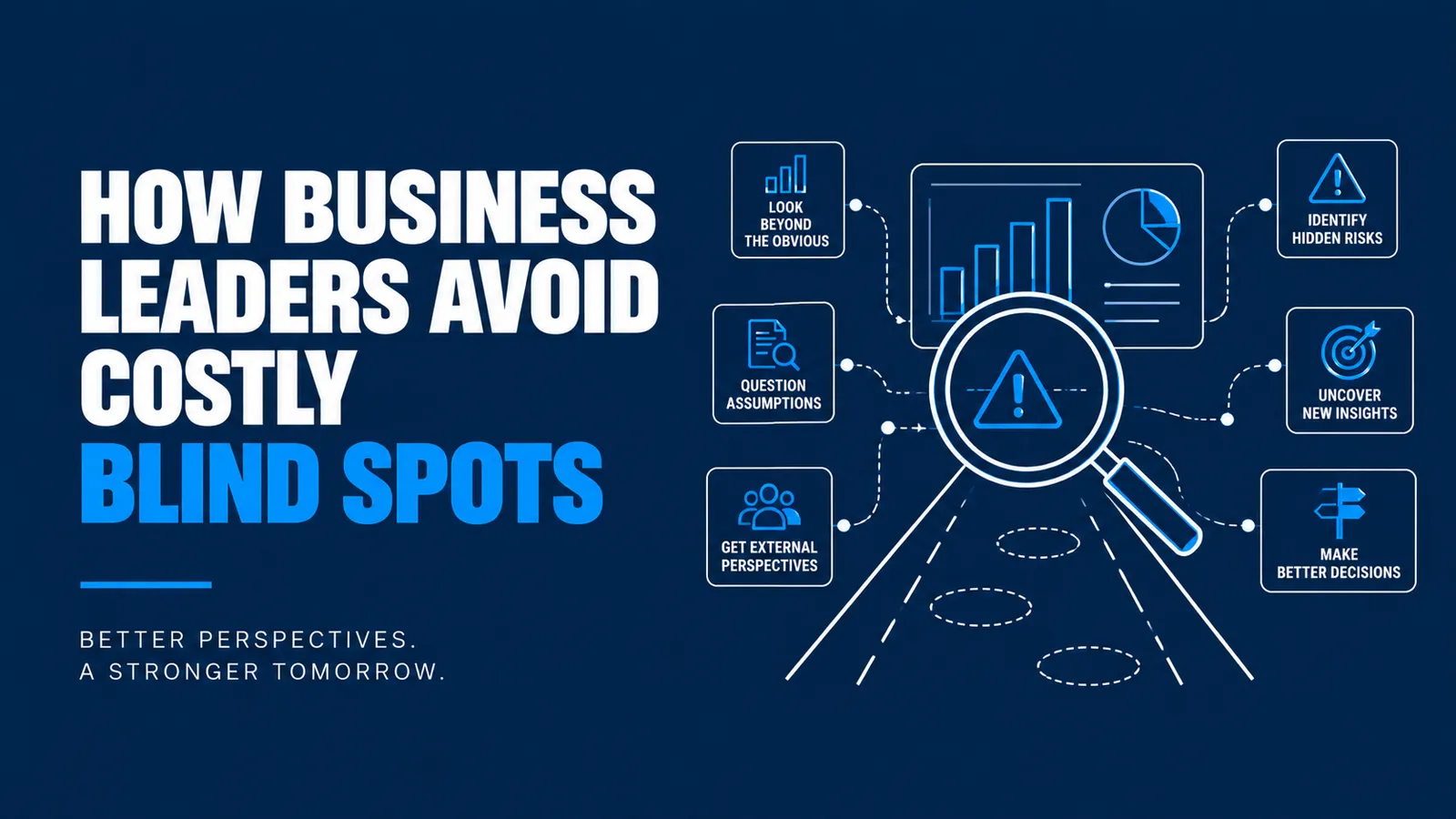
Every business leader makes decisions based on the information available to them.
The challenge is that no leader has perfect information.
No founder.
No CEO.
No investor.
No business owner.
Every decision is influenced by assumptions, experiences, beliefs, and available data.
This creates blind spots.
Not because leaders are careless.
But because it is impossible to see everything.
The most successful business leaders are not necessarily smarter than everyone else.
They are often better at identifying what they might be missing.
What Is A Business Blind Spot?
A blind spot is something that materially affects a decision but remains unnoticed.
It could be:
A flawed assumption
A changing customer behavior
A hidden market risk
A competitive threat
An operational weakness
An overlooked opportunity
Blind spots are dangerous because they are invisible.
Businesses rarely plan for problems they cannot see.
Why Blind Spots Become Expensive
Many business failures are not caused by a lack of effort.
They happen because leaders confidently move in the wrong direction.
The warning signs were often present.
The problem was that nobody recognized them.
Examples include:
Expanding too early
Hiring too aggressively
Misjudging customer demand
Ignoring changing market conditions
Overestimating competitive advantages
The cost of a blind spot increases with time.
The longer it remains unnoticed, the more expensive it becomes.
Blind Spot #1: Assuming Customers Think Like You
Founders and business owners spend significant time thinking about their products.
Customers do not.
This creates one of the most common business blind spots.
Leaders assume customers value the same things they value.
In reality, customers often prioritize:
Convenience
Simplicity
Trust
Speed
Outcomes
The only reliable way to avoid this blind spot is continuous customer interaction.
Blind Spot #2: Falling In Love With Past Success
Success creates confidence.
Sometimes too much confidence.
Strategies that worked in the past may no longer work today.
Markets evolve.
Competitors improve.
Customer expectations change.
Businesses that rely solely on historical success often struggle to adapt.
The best leaders constantly question whether yesterday's strengths remain relevant.
Blind Spot #3: Ignoring Weak Signals
Major business changes often begin as small signals.
A slight decline in customer engagement.
A new competitor.
A shift in buying behavior.
A change in customer feedback.
Many organizations ignore these signals because they appear insignificant.
Experienced leaders pay attention.
Small changes often become large trends.
Blind Spot #4: Internal Echo Chambers
As businesses grow, teams often begin thinking alike.
The same meetings.
The same assumptions.
The same perspectives.
Over time, disagreement decreases.
This creates an echo chamber.
Everyone agrees.
Nobody challenges assumptions.
Blind spots thrive in environments where difficult questions are rarely asked.
Blind Spot #5: Confusing Activity With Progress
Many businesses are busy.
Meetings increase.
Projects multiply.
Teams grow.
But activity does not always indicate progress.
Leaders sometimes assume effort equals results.
The real questions are:
Are customers benefiting?
Are margins improving?
Is retention increasing?
Is growth sustainable?
The wrong metrics can create dangerous blind spots.
Why Experience Helps Identify Blind Spots
One advantage experienced operators possess is pattern recognition.
They have seen:
Failed launches
Pricing mistakes
Growth challenges
Market expansion failures
Hiring problems
Strategic pivots
This experience allows them to identify risks that may not be obvious to others.
Often the warning signs appear familiar.
Because similar situations have happened before.
How Smart Leaders Challenge Their Own Thinking
Strong leaders rarely assume they have all the answers.
Instead, they actively test their thinking.
Questions they frequently ask include:
What assumptions are we making?
What evidence contradicts our beliefs?
What are we not seeing?
What could make this decision fail?
What would an outsider challenge?
These questions help uncover hidden risks before they become expensive problems.
The Value Of External Perspectives
One of the most effective ways to identify blind spots is through external perspectives.
People outside the business are often able to see issues more clearly.
Why?
Because they are not emotionally attached to existing assumptions.
They can challenge:
Strategies
Investments
Expansion plans
Product decisions
Hiring decisions
Without internal bias.
Often a single question from an experienced outsider can completely change how a problem is viewed.
A Simple Blind Spot Audit
Before making a major decision, ask:
What assumptions are driving this decision?
What evidence supports them?
What evidence challenges them?
What would happen if we are wrong?
Who has a different perspective?
What risks have we not discussed?
This exercise can reveal insights that would otherwise remain hidden.
Warning Signs You May Have A Blind Spot
Pay attention when:
✗ Everyone agrees immediately
✗ Customer feedback is ignored
✗ Growth slows unexpectedly
✗ Risks are dismissed quickly
✗ Decisions rely heavily on assumptions
✗ Nobody asks difficult questions
✗ External opinions are avoided
These situations often indicate that important perspectives may be missing.
How Experienced Operators Approach Blind Spots
Experienced operators understand a simple truth:
Every business has blind spots.
The goal is not eliminating them entirely.
The goal is finding them before they become expensive.
They seek feedback.
Challenge assumptions.
Review decisions objectively.
And actively look for what others may overlook.
Because the biggest risks are often the ones nobody is discussing.
Final Thoughts
Blind spots are a natural part of leadership.
Every decision is made with incomplete information.
The strongest leaders accept this reality.
They continuously question assumptions.
They seek alternative perspectives.
They encourage constructive disagreement.
And they remain open to learning.
Because avoiding costly mistakes is often less about making smarter decisions.
And more about seeing what others miss.
About Rytmove
Business Challenges. Trusted Second Opinions.
Rytmove helps founders, startup teams, SME owners, and business leaders gain clarity on important business decisions through conversations with experienced operators who have solved similar challenges before.
Whether you're evaluating growth opportunities, reviewing strategy, assessing investments, solving operational challenges, or making high-impact decisions, Rytmove helps you identify blind spots and make better decisions with confidence.
Website: https://rytmove.in