
Blog
How Experienced Operators Evaluate Risk
By the Rytmove Team · 21 Sept 2026
Every important business decision carries risk.
Launching a new product.
Entering a new market.
Hiring senior leaders.
Raising capital.
Acquiring another business.
Changing pricing.
Expanding operations.
The question is never:
"Is there risk?"
The real question is:
"Do we understand the risk well enough to make a smart decision?"
Many businesses fail because they focus only on potential rewards.
Experienced operators focus on both rewards and risks.
Because protecting downside is often as important as pursuing upside.
Why Risk Is Often Misunderstood
Many people view risk as something negative.
Experienced operators view it differently.
Risk is simply uncertainty.
Some risks create opportunities.
Others create losses.
The goal is not avoiding all risk.
If businesses avoided risk entirely, growth would never happen.
The goal is taking calculated risks with informed judgment.
The First Question Experienced Operators Ask
Before evaluating any opportunity, experienced operators ask:
"What could go wrong?"
This sounds simple.
But it changes how decisions are made.
Instead of focusing only on success scenarios, they evaluate:
Failure scenarios
Execution challenges
Market risks
Financial risks
Competitive threats
Operational risks
This creates a more balanced view of reality.
Risk Category #1: Market Risk
Market risk answers a fundamental question:
Do enough customers actually want this?
Many businesses invest heavily before validating demand.
Experienced operators investigate:
Market size
Customer pain points
Demand signals
Competitive landscape
Buying behavior
A great product in the wrong market remains a poor investment.
Risk Category #2: Execution Risk
Even strong strategies can fail because of poor execution.
Questions include:
Do we have the right team?
Do we have the required expertise?
Are timelines realistic?
Are resources sufficient?
Execution risk is often underestimated because teams naturally assume they can overcome challenges.
Experienced operators test those assumptions.
Risk Category #3: Financial Risk
Every decision has financial implications.
Operators assess:
Investment required
Cash flow impact
Break-even timeline
Downside exposure
Capital requirements
A decision may appear attractive until financial risk is fully understood.
Protecting cash remains one of the most important business disciplines.
Risk Category #4: Competitive Risk
Competitors rarely remain static.
Many businesses evaluate opportunities assuming competitors will not respond.
Experienced operators ask:
How might competitors react?
What advantages do they possess?
Can they replicate our approach?
How quickly can they adapt?
Competitive responses often determine long-term success.
Risk Category #5: Operational Risk
Growth frequently creates operational challenges.
Questions include:
Can systems handle increased demand?
Are processes scalable?
Is leadership bandwidth sufficient?
Are dependencies understood?
Operational risk often appears only after growth begins.
Which is why experienced operators evaluate it early.
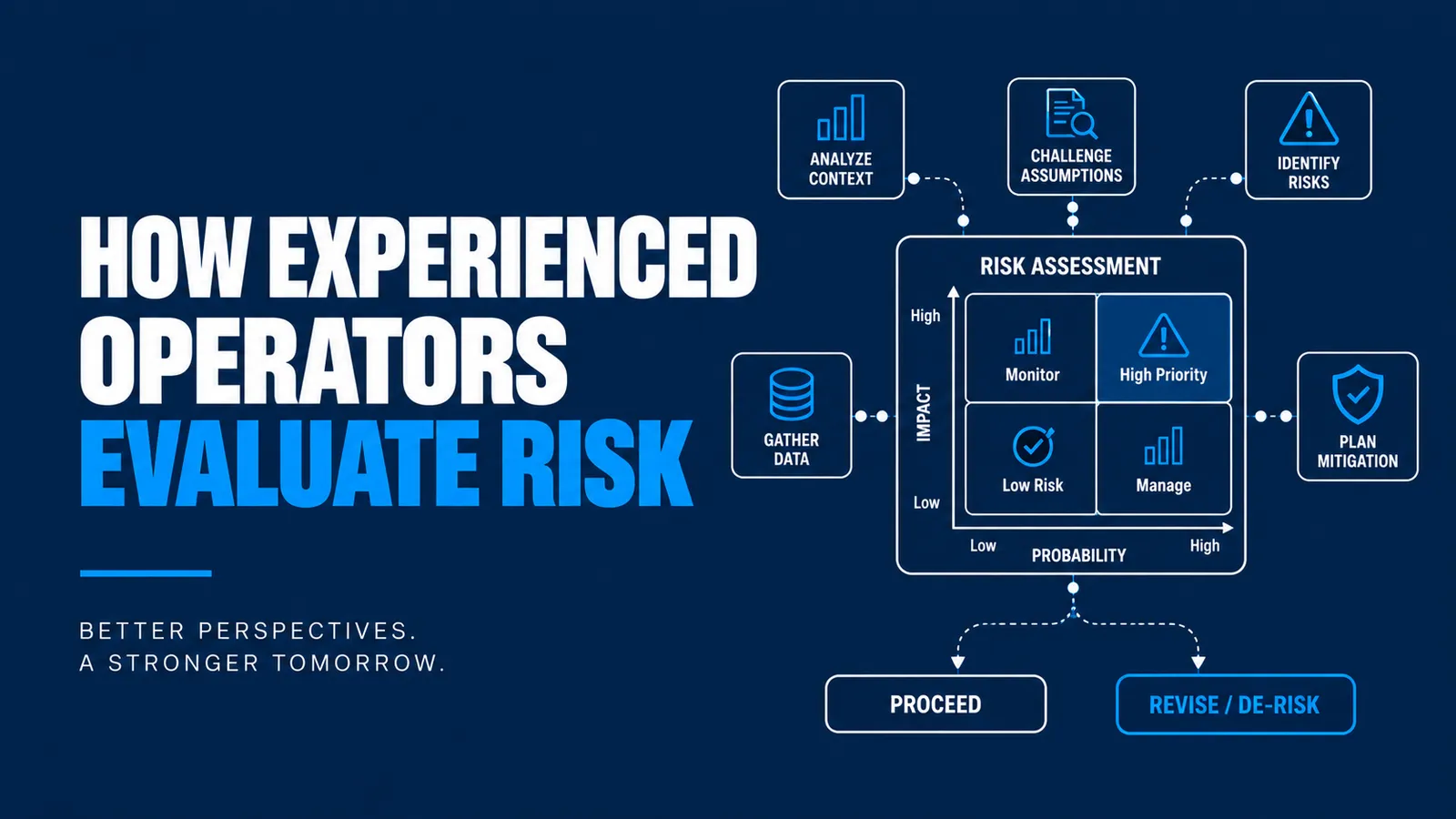
The Probability Vs Impact Framework
One of the simplest risk evaluation tools is a probability-impact matrix.
For every major risk, ask:
How likely is it?
And
How severe would the impact be?
Risks generally fall into four categories:
Low Probability + Low Impact
Usually acceptable.
High Probability + Low Impact
Manage and monitor.
Low Probability + High Impact
Prepare contingency plans.
High Probability + High Impact
Requires immediate attention.
This framework helps prioritize effort and resources.
The Best Operators Focus On Downside Protection
Many inexperienced leaders focus primarily on upside.
Experienced operators focus heavily on downside.
They ask:
"What happens if we're wrong?"
Questions include:
What's the worst-case scenario?
How much could we lose?
Can we recover?
How quickly would problems become visible?
Can risks be limited?
This thinking protects businesses from catastrophic outcomes.
Why Assumptions Matter
Every risk assessment depends on assumptions.
If assumptions are incorrect, risk analysis becomes unreliable.
Experienced operators continuously challenge assumptions:
Customer demand
Growth projections
Pricing expectations
Cost estimates
Market conditions
The more critical the assumption, the more important it is to validate.
How Experienced Operators Reduce Risk
Risk cannot be eliminated.
But it can often be reduced.
Common approaches include:
Pilot programs
Small-scale launches
Market validation
Customer interviews
Scenario planning
Financial stress testing
External reviews
Rather than betting everything at once, they learn before scaling.
The Value Of External Perspectives
One reason experienced operators seek second opinions is risk identification.
Internal teams often share similar assumptions.
External perspectives can reveal:
Blind spots
Hidden dependencies
Overlooked threats
Alternative strategies
Better decision pathways
Often the most valuable insight is a risk nobody inside the company considered.
Warning Signs That Risk Is Being Ignored
Be cautious when:
✗ Decisions are rushed
✗ Assumptions remain untested
✗ Teams focus only on positive outcomes
✗ Dissenting opinions are discouraged
✗ Financial downside is unclear
✗ Market validation is weak
✗ Growth projections appear overly optimistic
These signals often indicate inadequate risk assessment.
How Experienced Operators Think About Risk
Experienced operators rarely ask:
"Will this work?"
Instead they ask:
What must be true for success?
What could cause failure?
How likely is each scenario?
What is the downside?
Can we limit losses?
Is the potential reward worth the risk?
This approach creates stronger decisions over time.
Final Thoughts
Risk is not the enemy of growth.
Unmanaged risk is.
The best operators are not successful because they avoid risk.
They are successful because they understand it better.
They identify risks early.
They challenge assumptions.
They test before scaling.
And they make decisions with a clear understanding of both opportunity and downside.
Because in business, the goal is not eliminating uncertainty.
The goal is making informed decisions despite it.
About Rytmove
Business Challenges. Trusted Second Opinions.
Rytmove helps founders, startup teams, SME owners, and business leaders gain clarity on important business decisions through conversations with experienced operators who have solved similar challenges before.
Whether you're evaluating investments, entering new markets, launching products, planning growth initiatives, or assessing business risks, Rytmove helps you make better decisions with confidence.
Website: https://rytmove.in