
Blog
How to Break Through a Business Growth Plateau
By the Rytmove Team · 20 Sept 2026
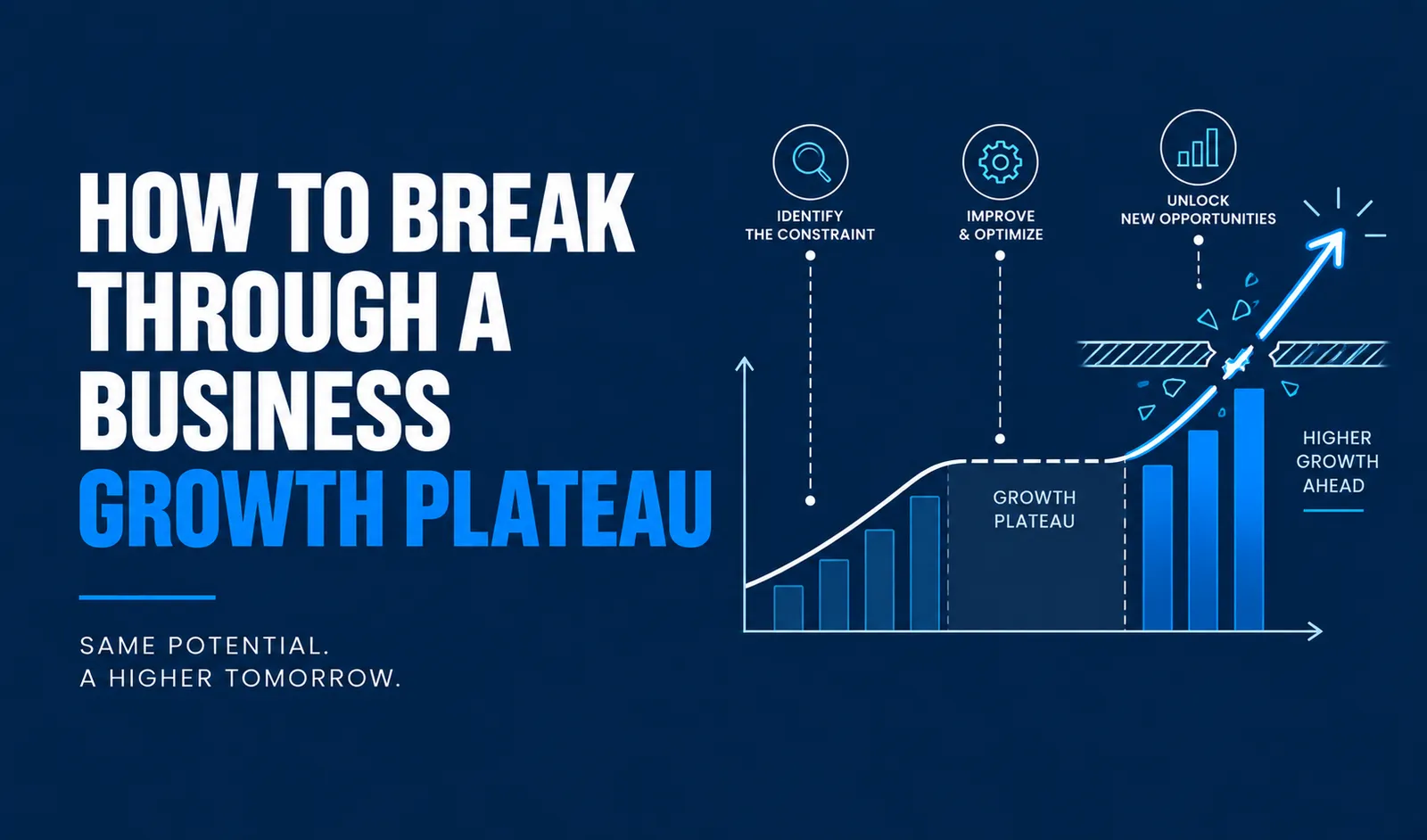
Every business owner wants growth.
More customers.
More revenue.
More opportunities.
More momentum.
In the early stages, growth often feels natural.
New customers arrive.
Sales increase.
The market responds positively.
Then something changes.
Revenue levels off.
Customer acquisition slows.
Growth becomes harder.
The business enters what many founders fear most:
A growth plateau.
Growth plateaus are common.
In fact, most successful businesses experience them multiple times throughout their journey.
The difference between businesses that continue growing and those that stagnate often comes down to how they respond.
What Is A Business Growth Plateau?
A business growth plateau occurs when growth slows significantly or stops altogether.
Revenue stabilizes.
Customer acquisition becomes inconsistent.
Profitability stops improving.
The business remains operational but struggles to move forward.
Growth plateaus can occur at any stage:
Early-stage startups
• Growing SMEs
Mature businesses
Large enterprises
The causes vary, but the symptoms are often similar.
Why Growth Plateaus Happen
Most founders assume growth plateaus occur because demand has disappeared.
In reality, demand is rarely the only issue.
Growth usually slows because a constraint has emerged.
The business has reached the limit of a particular system, process, strategy, or capability.
Every stage of growth creates new bottlenecks.
What worked previously may no longer be enough.
Reason #1: Customer Acquisition Channels Are Saturated
Many businesses rely heavily on a single growth channel.
For example:
Paid advertising
Referrals
SEO
Outbound sales
Initially, results are strong.
Over time, performance declines.
Competition increases.
Costs rise.
Conversion rates fall.
When a growth channel reaches saturation, businesses often experience a plateau.
The solution is usually diversification.
New acquisition channels create new growth opportunities.
Reason #2: Product Market Fit Has Shifted
Markets evolve constantly.
Customer expectations change.
Competitors improve.
Technology advances.
A product that achieved strong Product Market Fit two years ago may no longer solve customer problems as effectively today.
Warning signs include:
Lower retention
Reduced engagement
Declining referrals
Increased churn
Businesses that continuously listen to customers often identify these changes earlier.
Reason #3: The Founder Has Become The Constraint
Many businesses outgrow founder-led decision making.
Every approval requires founder input.
Every important decision flows upward.
Teams become dependent.
Execution slows.
Growth eventually stalls.
Founders must transition from operators to leaders.
The ability to build systems becomes more important than personal involvement.
Reason #4: Operations Cannot Scale Further
Operational bottlenecks are common growth killers.
Examples include:
Manual processes
Capacity limitations
Inefficient workflows
Poor technology systems
Resource constraints
A business may continue attracting customers while struggling to serve them effectively.
Growth slows because operational capability has reached its limit.
Reason #5: The Business Has Lost Focus
Success often creates opportunities.
New products.
New markets.
New partnerships.
New customer segments.
Many businesses attempt to pursue everything simultaneously.
Resources become fragmented.
Execution quality declines.
Teams become distracted.
Growth frequently returns when focus improves.
Reason #6: Pricing Is Limiting Growth
Pricing affects far more than revenue.
It influences:
Profitability
Customer perception
Marketing budgets
Hiring capacity
Growth investments
Businesses that underprice their offerings often struggle to generate the resources required for expansion.
Pricing reviews can reveal significant growth opportunities.
Reason #7: Customer Retention Is Weak
Many businesses focus heavily on acquisition.
Fewer focus on retention.
Yet retention is often one of the strongest growth drivers.
Questions to consider:
Are customers renewing?
Are they purchasing repeatedly?
Are they increasing usage?
Are they recommending others?
Improving retention often generates more growth than increasing acquisition.
How Experienced Operators Break Through Plateaus
Experienced operators rarely respond to plateaus by simply working harder.
Instead, they diagnose the constraint.
They ask:
What is limiting growth?
What changed recently?
Where are customers dropping off?
Which process is slowing execution?
Which assumptions are no longer valid?
The goal is not more activity.
The goal is identifying the bottleneck.
Strategy #1: Revisit Customer Conversations
Growth plateaus often reveal changing customer needs.
Founders should spend time speaking directly with customers.
Ask:
What challenges are most important today?
Why do customers stay?
Why do customers leave?
What alternatives are they considering?
Customer insights frequently uncover growth opportunities that data alone cannot reveal.
Strategy #2: Strengthen Existing Customers
Many businesses overlook their existing customer base.
Growth opportunities often exist through:
Upselling
Cross-selling
Renewals
Referrals
Expanded usage
Acquiring new customers is usually more expensive than growing existing relationships.
Strategy #3: Remove Operational Bottlenecks
Every growing business eventually encounters operational constraints.
Common solutions include:
Automation
Process redesign
Better tools
Team restructuring
Capacity expansion
Removing bottlenecks often unlocks growth without additional marketing spend.
Strategy #4: Improve Strategic Focus
Not every opportunity deserves attention.
Businesses frequently accelerate growth by deciding what not to pursue.
Focus improves:
Resource allocation
Team alignment
Execution quality
Strategic clarity
The most successful companies are often remarkably focused.
Strategy #5: Explore New Growth Channels
Growth channels have life cycles.
What worked before may not work forever.
Businesses should continuously test:
Partnerships
Content marketing
SEO
Referrals
Communities
Outbound sales
Strategic alliances
New channels can create entirely new growth curves.
Questions Every Founder Should Ask During A Plateau
When growth slows, ask:
What is the biggest constraint today?
Has customer behavior changed?
Are retention rates improving or declining?
Which channel is becoming less effective?
What process would break if demand doubled tomorrow?
Are we focused on the right priorities?
The answers often reveal where growth is hiding.
Growth Plateaus Are Not Failures
Many founders interpret plateaus as signs of failure.
They are not.
Growth plateaus often signal transition points.
The business has outgrown one stage and must evolve to reach the next.
Almost every successful company has experienced periods where growth slowed.
The difference is that strong businesses adapt.
They identify constraints.
They adjust strategies.
They build new capabilities.
Then growth resumes.
Final Thoughts
Business growth rarely follows a straight line.
Periods of rapid growth are often followed by plateaus.
The businesses that break through are not necessarily the ones with the largest budgets or the biggest teams.
They are the ones that understand their constraints.
Because growth plateaus are rarely caused by a lack of effort.
They are usually caused by a bottleneck waiting to be identified and removed.
Find the constraint.
Solve it.
Growth often follows.
About Rytmove
Business Challenges. Trusted Second Opinions.
Rytmove helps founders, startup teams, SME owners, and business leaders gain clarity on important business decisions through conversations with experienced operators who have solved similar challenges before.
Whether you're overcoming a growth plateau, evaluating Product Market Fit, reviewing pricing strategy, scaling operations, or planning expansion, Rytmove helps you make better decisions with confidence.
Website: https://rytmove.in