
Blog
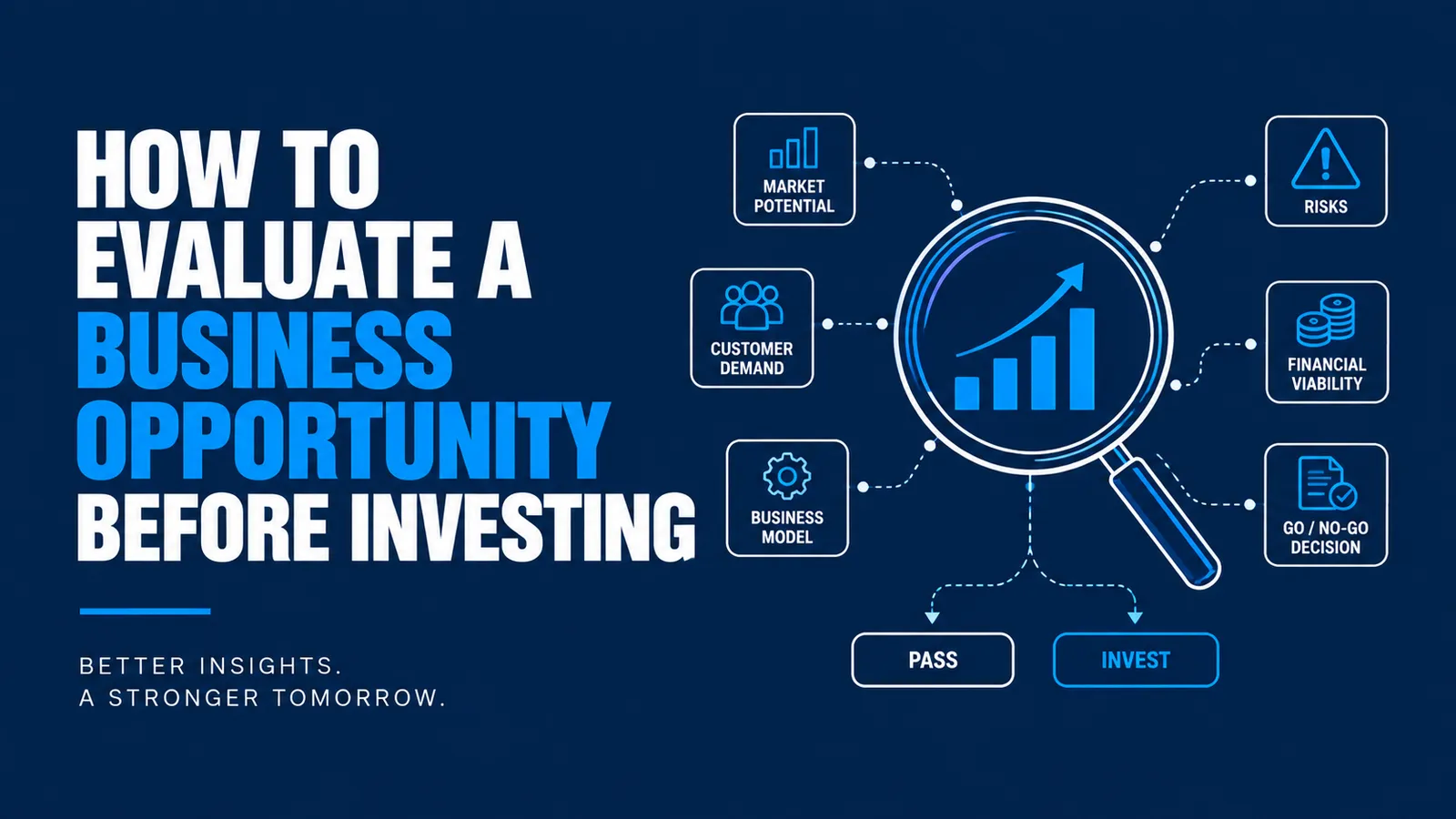
How to Evaluate a Business Opportunity Before Investing
By the Rytmove Team · 21 Sept 2026
Opportunities are everywhere.
A new startup idea.
A franchise offer.
A partnership proposal.
A market expansion.
An acquisition.
A new product category.
An investment pitch.
Some opportunities create extraordinary value.
Others consume time, money, and resources without delivering meaningful returns.
The challenge is that they often look similar at the beginning.
Excitement can easily be mistaken for potential.
That is why experienced investors and business operators rely on structured evaluation rather than intuition alone.
Before committing capital, time, or attention, it is important to determine whether an opportunity is genuinely attractive or simply appears attractive.
Why Opportunity Evaluation Matters
Every investment has a cost.
Not just financial cost.
There is also:
Time
Attention
Resources
Management bandwidth
Opportunity cost
Choosing one opportunity often means saying no to another.
A poor investment can delay growth for years.
A strong investment can accelerate it significantly.
The quality of opportunities matters.
But the quality of evaluation matters even more.
The Biggest Mistake Investors Make
Most poor investment decisions begin with excitement.
The market appears large.
The founder sounds confident.
The projections look impressive.
The story feels compelling.
The problem is simple.
Stories are easy.
Execution is difficult.
Experienced investors spend less time evaluating presentations and more time evaluating fundamentals.
Question #1: What Problem Is Being Solved?
Every successful business solves a meaningful problem.
The first question should always be:
What problem does this opportunity solve?
Then ask:
Is the problem real?
How painful is it?
Who experiences it?
How frequently does it occur?
Businesses solving urgent problems generally perform better than businesses solving minor inconveniences.
Strong demand starts with strong pain points.
Question #2: Is There Evidence Of Demand?
Assumptions are dangerous.
Evidence is valuable.
Before investing, look for signs that customers genuinely want the solution.
Examples include:
Paying customers
Repeat customers
Customer retention
Referrals
Market traction
Interest alone is insufficient.
Payment is often a stronger signal than enthusiasm.
Question #3: How Large Is The Market?
Even exceptional businesses can struggle in small markets.
Evaluate:
Total market size
Growth rate
Competitive intensity
Future potential
A large market does not guarantee success.
But a tiny market often limits upside.
The goal is finding opportunities where demand can support meaningful growth.
Question #4: What Competitive Advantage Exists?
Competition is inevitable.
The important question is:
Why will this business win?
Potential advantages include:
Brand strength
Distribution
Technology
Network effects
Customer relationships
Operational efficiency
If competitors can easily replicate the offering, long-term success becomes more difficult.
Sustainable advantages create long-term value.
Question #5: Who Is Behind The Opportunity?
People matter.
In many cases, the quality of leadership is more important than the idea itself.
Evaluate:
Industry experience
Execution capability
Track record
Adaptability
Integrity
Markets change.
Strategies evolve.
Strong leaders often navigate uncertainty better than weak leaders operating in attractive markets.
Question #6: Do The Economics Make Sense?
Growth is not enough.
The business must eventually create value.
Review:
Revenue model
Gross margins
Customer acquisition costs
Customer lifetime value
Profitability potential
A business can generate revenue while still destroying value.
Unit economics reveal reality.
Question #7: What Are The Major Risks?
Every opportunity carries risk.
The goal is not eliminating risk.
The goal is understanding it.
Potential risks may include:
Market risk
Execution risk
Competitive risk
Regulatory risk
Financial risk
Technology risk
The strongest decisions occur when risks are visible and manageable.
Hidden risks are often the most dangerous.
Question #8: What Happens If Things Go Wrong?
Optimistic projections are common.
Stress testing is rare.
Ask:
What if growth is slower?
What if costs increase?
What if customer acquisition becomes harder?
What if competitors react aggressively?
Strong opportunities remain viable even when assumptions become less favorable.
Question #9: Is The Timing Right?
Good opportunities can fail because of poor timing.
Markets may be:
Too early
Too crowded
Too mature
Too uncertain
Timing often influences outcomes as much as execution.
The right idea at the wrong time can struggle.
The right idea at the right time can scale rapidly.
Question #10: What Is The Opportunity Cost?
Every investment competes against alternatives.
Before proceeding, ask:
What else could these resources be used for?
Capital invested here cannot be invested elsewhere.
Time spent here cannot be spent elsewhere.
The best opportunity is not always the attractive opportunity.
It is often the opportunity with the strongest risk-adjusted return.
How Experienced Operators Evaluate Opportunities
Experienced operators rarely become excited quickly.
They become curious.
They ask:
What assumptions are driving this opportunity?
What evidence supports those assumptions?
What could go wrong?
What would make this opportunity exceptional?
What would make it fail?
They focus on learning before committing.
Because disciplined evaluation usually produces better outcomes than rapid enthusiasm.
A Simple Opportunity Evaluation Framework
Before investing, score the opportunity across five areas:
1. Problem Strength
Is the problem significant enough?
2. Market Potential
Can the market support growth?
3. Competitive Advantage
Is differentiation sustainable?
4. Leadership Capability
Can the team execute?
5. Financial Viability
Do the economics work?
Weakness in one category does not automatically eliminate an opportunity.
But multiple weaknesses should create caution.
Signs Of A Strong Business Opportunity
Strong opportunities often demonstrate:
Clear customer pain
Proven demand
Attractive market size
Competitive advantages
Strong leadership
Healthy economics
Manageable risks
Favorable timing
The more signals align, the stronger the opportunity becomes.
Final Thoughts
Most investment mistakes do not happen because opportunities are invisible.
They happen because opportunities are evaluated emotionally rather than objectively.
Excitement is valuable.
But discipline is essential.
The strongest investors and business leaders consistently ask difficult questions before committing resources.
Because the goal is not finding opportunities.
The goal is finding the right opportunities.
And that requires careful evaluation.
About Rytmove
Business Challenges. Trusted Second Opinions.
Rytmove helps founders, startup teams, SME owners, and business leaders gain clarity on important business decisions through conversations with experienced operators who have solved similar challenges before.
Whether you're evaluating an investment opportunity, considering a partnership, planning expansion, reviewing acquisitions, or validating a new business idea, Rytmove helps you make better decisions with confidence.
Website: https://rytmove.in