
Blog
Questions Every Business Leader Should Ask Before Making a Major Decision
By the Rytmove Team · 23 Sept 2026
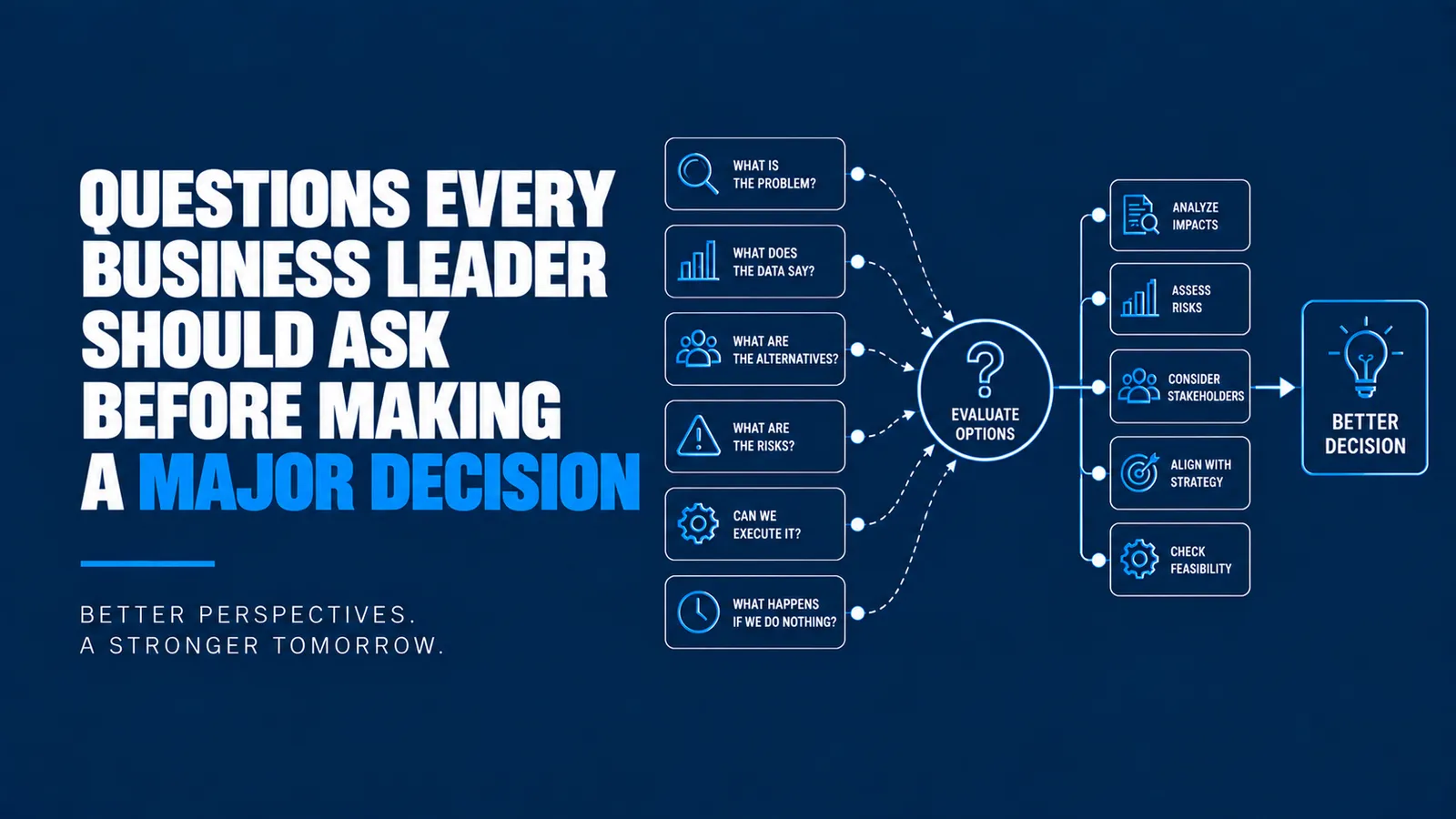
Every business leader faces decisions that can significantly impact the future of the organization.
Launching a new product.
Entering a new market.
Hiring senior leadership.
Making an acquisition.
Raising capital.
Investing in growth.
Changing pricing.
The challenge is not simply making decisions.
The challenge is making good decisions.
While no framework guarantees success, asking the right questions before committing resources can dramatically improve outcomes.
Why Good Decisions Start With Good Questions
Many leaders focus on finding answers.
Experienced leaders focus on asking better questions.
Questions reveal assumptions.
Questions expose risks.
Questions uncover blind spots.
Questions improve clarity.
Often, the quality of a decision is determined long before the final choice is made.
It is determined by the quality of the thinking that precedes it.
Question #1: What Problem Are We Actually Solving?
Many organizations jump directly into solutions.
Without fully understanding the problem.
Ask:
What specific problem exists?
How significant is it?
What evidence supports it?
Are we solving the root cause or a symptom?
Misdiagnosing the problem often leads to ineffective decisions.
Question #2: What Assumptions Are We Making?
Every decision is built upon assumptions.
Examples include:
Market demand assumptions
Customer behavior assumptions
Pricing assumptions
Competitive assumptions
Execution assumptions
The key question is:
"What must be true for this decision to succeed?"
Identifying assumptions makes risk visible.
Question #3: What Evidence Supports This Decision?
Strong decisions balance judgment with evidence.
Ask:
What data supports this direction?
What customer feedback exists?
What market signals are visible?
What insights are based on facts rather than opinions?
Evidence does not eliminate uncertainty.
But it improves confidence.
Question #4: What Evidence Challenges This Decision?
Leaders naturally seek information that confirms their beliefs.
This is known as confirmation bias.
Before proceeding, ask:
What evidence suggests we may be wrong?
What are critics likely to say?
What risks are being overlooked?
The goal is not to kill ideas.
The goal is to stress-test them.
Question #5: What Are The Alternatives?
Many organizations evaluate a single option.
Strong decision-making requires comparison.
Ask:
What other approaches exist?
What would we do if this option were unavailable?
Are we considering enough alternatives?
Better alternatives often emerge when leaders broaden the discussion.
Question #6: What Happens If We Do Nothing?
Many decisions compare multiple actions.
Few compare action against inaction.
Ask:
What happens if we wait?
What opportunities may be missed?
What risks increase over time?
What is the cost of delay?
Sometimes doing nothing is the highest-risk option.
Question #7: What Are The Second-Order Effects?
First-order effects are usually obvious.
Second-order effects often determine success.
For example:
A discount may increase sales.
But it may also reduce margins.
Change customer expectations.
And weaken future pricing power.
Ask:
"What happens next?"
Then ask:
"What happens after that?"
Question #8: Can We Execute This Successfully?
Many strategies fail during execution.
Not planning.
Ask:
Do we have the required capabilities?
Do we have the right people?
Do we have sufficient resources?
What operational challenges exist?
A good strategy that cannot be executed remains a bad decision.
Question #9: What Is The Worst Plausible Outcome?
Optimism is valuable.
But risk assessment is essential.
Ask:
What could go wrong?
How severe would the impact be?
Can we absorb the downside?
How would we respond?
Understanding downside risk improves resilience.
Question #10: How Will We Know If We Are Wrong?
Every decision should include feedback mechanisms.
Ask:
What metrics matter?
What signals indicate success?
What signals indicate failure?
How quickly can we detect problems?
The faster businesses learn, the faster they improve.
Question #11: Who Has Solved This Before?
Many organizations assume their challenges are unique.
Often they are not.
Ask:
Who has faced similar decisions?
What lessons can we learn?
What mistakes should we avoid?
Learning from experience accelerates decision quality.
Question #12: What Are We Not Seeing?
Every leader has blind spots.
Every team has blind spots.
Ask:
What perspectives are missing?
Who disagrees with us?
What assumptions remain unchallenged?
What risks may be hidden?
This question often reveals the most valuable insights.
Why Experienced Leaders Ask More Questions
Less experienced leaders often seek certainty.
Experienced leaders seek understanding.
They recognize that business decisions rarely involve perfect information.
Instead of looking for guarantees, they focus on:
Better assumptions
Better evidence
Better risk assessment
Better perspectives
Better judgment
This improves outcomes over time.
Final Thoughts
Great business decisions rarely come from having all the answers.
They come from asking the right questions.
Questions expose assumptions.
Reveal risks.
Improve clarity.
And strengthen judgment.
Before making your next major business decision, slow down and ask better questions.
The answers may change the outcome.
About Rytmove
Business Challenges. Trusted Second Opinions.
Rytmove helps founders, startup teams, SME owners, and business leaders gain clarity on important business decisions through conversations with experienced operators who have solved similar challenges before.
Whether you're evaluating growth opportunities, reviewing strategy, assessing investments, planning expansion, or navigating major business decisions, Rytmove helps you ask better questions and make better decisions with confidence.
Website: https://rytmove.in