
Blog
Scaling Too Early: Warning Signs Founders Miss
By the Rytmove Team · 20 Sept 2026
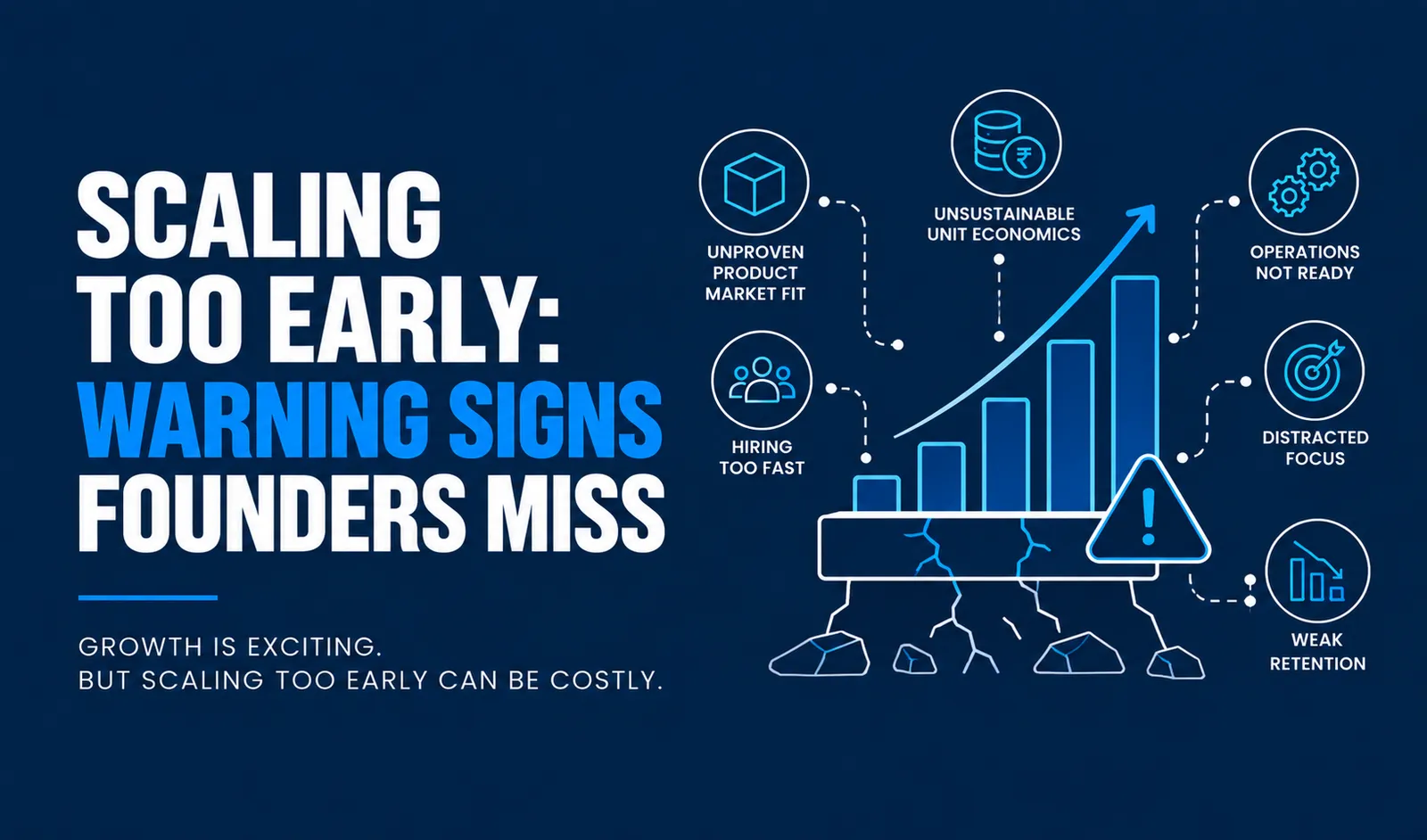
Every founder wants growth.
More customers.
More revenue.
More employees.
More visibility.
More momentum.
When a startup starts showing positive signs, the natural instinct is to scale.
Increase marketing budgets.
Hire aggressively.
Expand into new markets.
Launch additional products.
Invest heavily in growth.
But there is a dangerous assumption hidden inside many growth plans.
The assumption that early traction automatically means the business is ready to scale.
In reality, premature scaling is one of the most common reasons startups fail.
Many founders believe they have found a winning formula when they have only found early signals.
The difference can be extremely expensive.
What Does Scaling Actually Mean?
Scaling is not simply growing.
Growth and scaling are different.
Growth usually means adding resources to generate more revenue.
Scaling means increasing revenue faster than costs increase.
Successful scaling requires:
Repeatable customer acquisition
Strong customer retention
Operational stability
Predictable unit economics
• Product Market Fit
Without these foundations, scaling often magnifies existing weaknesses.
Why Founders Scale Too Early
The pressure to grow comes from multiple directions.
Investors expect growth.
Competitors are expanding.
Customers are requesting more features.
The market appears attractive.
Positive momentum creates confidence.
Sometimes too much confidence.
Founders often mistake:
Early adoption for Product Market Fit
Initial revenue for sustainable demand
Customer interest for customer commitment
Growth potential for growth readiness
The result is premature scaling.
Warning Sign #1: Product Market Fit Is Unclear
Product Market Fit should come before scaling.
Yet many startups attempt to scale before validating it.
Questions worth asking include:
Are customers staying?
Are they returning regularly?
Are they referring others?
Are they willing to pay consistently?
Would they miss the product if it disappeared?
If these answers remain uncertain, scaling may be premature.
Growth cannot fix weak Product Market Fit.
Warning Sign #2: Customer Retention Is Weak
Acquiring customers is important.
Keeping them is essential.
Many founders celebrate customer acquisition while ignoring customer retention.
If customers leave shortly after joining, scaling becomes expensive.
Poor retention often indicates:
Limited customer value
Weak onboarding
Wrong target audience
Insufficient differentiation
Retention should improve before acquisition budgets increase.
Warning Sign #3: Unit Economics Are Unproven
Many startups grow revenue while losing money on every customer.
This creates dangerous momentum.
The business appears successful.
The economics say otherwise.
Key questions include:
• What is Customer Acquisition Cost (CAC)?
• What is Customer Lifetime Value (LTV)?
Are customers profitable?
Are margins improving?
Scaling unprofitable economics usually accelerates losses.
Warning Sign #4: Customer Acquisition Is Not Repeatable
A few successful sales do not prove scalability.
Early customers often arrive through:
Founder networks
Personal referrals
Industry relationships
Existing contacts
These channels may not scale.
Before investing heavily in growth, founders should understand:
Which acquisition channels work?
Which customer segments convert best?
What acquisition costs look like?
Whether demand is repeatable
Predictability matters more than isolated success.
Warning Sign #5: Operations Break Under Pressure
A business should survive growth before pursuing more growth.
Operational warning signs include:
Missed deadlines
Customer complaints
Process failures
Team confusion
Quality issues
If operations struggle with current demand, larger volumes will create bigger problems.
Scaling amplifies operational weaknesses.
Warning Sign #6: The Founder Is Still Doing Everything
Many early-stage startups rely heavily on founders.
Founders manage:
Sales
Customer support
Hiring
Product decisions
Operations
This is normal initially.
But businesses become difficult to scale when everything depends on one person.
Before scaling, founders should build systems that reduce dependency.
Growth requires delegation.
Warning Sign #7: Hiring Is Outpacing Clarity
Growth often encourages rapid hiring.
More people appear to mean faster execution.
Not always.
Premature hiring frequently creates:
Higher burn rates
Role confusion
Management complexity
Communication challenges
Founders should ensure that roles, responsibilities, and priorities are clearly defined before expanding teams.
Warning Sign #8: Too Many Growth Initiatives
Growth creates opportunities.
New products.
New markets.
New customer segments.
New partnerships.
Founders often pursue all of them simultaneously.
Focus disappears.
Execution quality declines.
Businesses scale most effectively when they solve one challenge at a time.
Focus creates momentum.
Distraction creates complexity.
The Hidden Cost Of Premature Scaling
The consequences extend beyond financial losses.
Premature scaling often creates:
Cash flow pressure
Team burnout
Customer dissatisfaction
Product complexity
Strategic confusion
Reduced investor confidence
These problems become increasingly difficult to reverse as the organization grows.
How Experienced Operators Think About Scaling
Experienced operators rarely ask:
"How fast can we grow?"
Instead, they ask:
"Are we ready to grow?"
They focus on:
• Product Market Fit
Customer retention
Unit economics
Operational readiness
Team capability
Leadership capacity
They understand that growth magnifies everything.
Including mistakes.
Questions Every Founder Should Ask Before Scaling
Before making major growth investments, ask:
Do customers consistently stay?
Is demand repeatable?
Are unit economics healthy?
Can operations handle double the volume?
Are teams aligned?
Are processes documented?
What breaks if growth accelerates tomorrow?
The answers often reveal whether the business is truly ready.
When Is The Right Time To Scale?
There is no perfect formula.
But strong indicators often include:
Consistent customer retention
Predictable acquisition channels
Healthy unit economics
Operational stability
✓ Strong Product Market Fit
Team readiness
Leadership capacity
When these elements align, scaling becomes significantly less risky.
Final Thoughts
Growth is exciting.
Scaling is powerful.
But timing matters.
The biggest startup mistakes often happen when founders confuse early traction with long-term readiness.
Premature scaling does not solve business problems.
It amplifies them.
The strongest founders focus on building a solid foundation before accelerating growth.
Because sustainable growth is rarely about moving faster.
It is about ensuring the business is ready for what comes next.
About Rytmove
Business Challenges. Trusted Second Opinions.
Rytmove helps founders, startup teams, SME owners, and business leaders gain clarity on important business decisions through conversations with experienced operators who have solved similar challenges before.
Whether you're evaluating Product Market Fit, planning growth, reviewing scaling decisions, assessing operational readiness, or considering expansion opportunities, Rytmove helps you make better decisions with confidence.
Website: https://rytmove.in