
Blog
Strategic Decisions That Deserve a Second Opinion
By the Rytmove Team · 21 Sept 2026
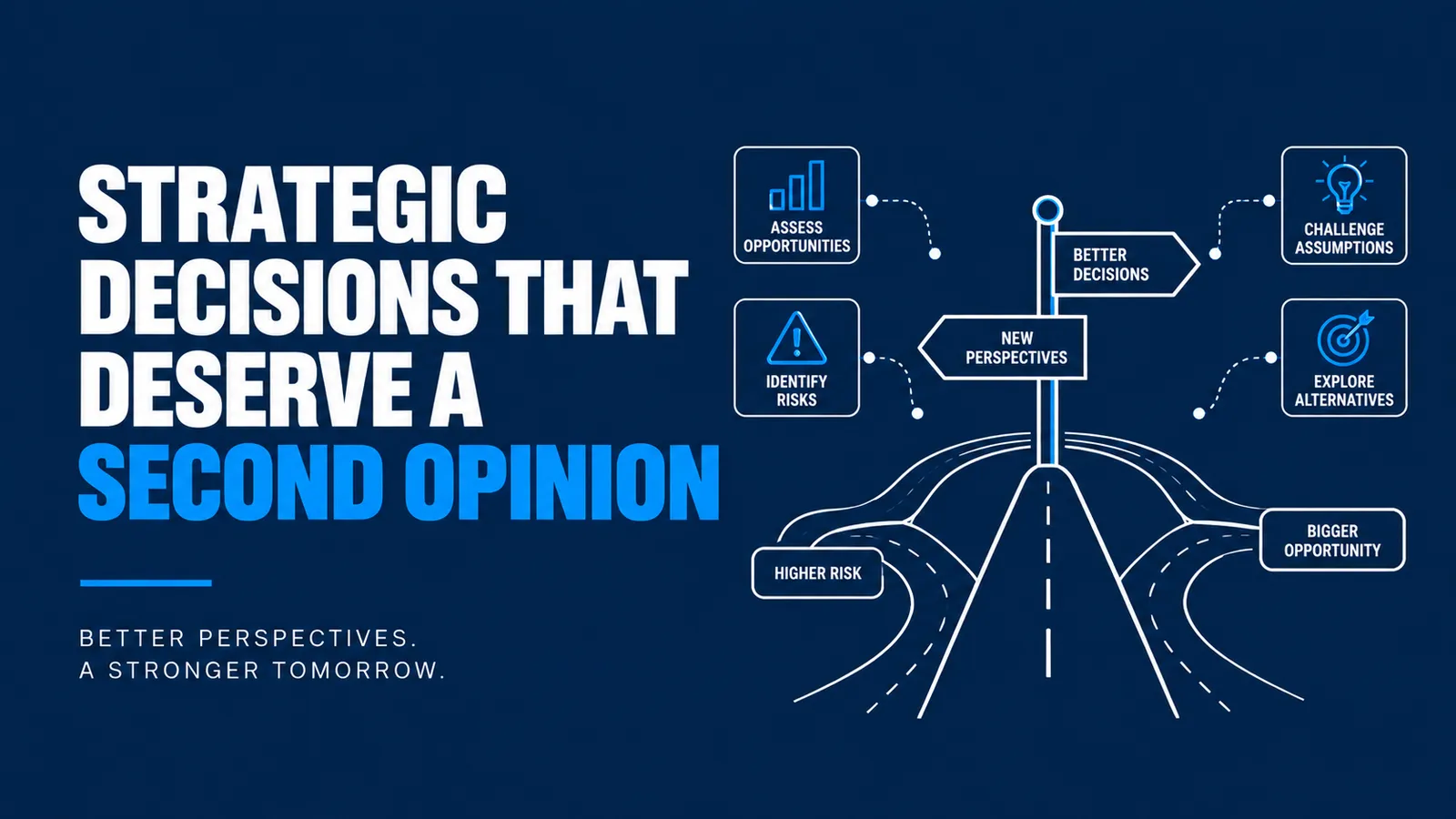
Every business leader makes decisions.
Some are routine.
Others shape the future of the company.
A pricing change.
A new market entry.
A product launch.
A major hire.
An acquisition.
A strategic partnership.
These decisions often involve significant investments of time, money, and resources.
The challenge is simple.
When you're deeply involved in a business, objectivity becomes difficult.
You see the problem every day.
You hear the same opinions.
You work with the same assumptions.
And sometimes that creates blind spots.
That is why experienced leaders often seek a second opinion before making major strategic decisions.
Not because they cannot decide.
But because they understand the cost of getting important decisions wrong.
Why Smart Leaders Seek Second Opinions
In medicine, obtaining a second opinion before a major procedure is common.
Business decisions deserve the same discipline.
A second opinion can help:
Identify hidden risks
Challenge assumptions
Reveal overlooked opportunities
Validate strategic thinking
Improve decision confidence
The goal is not replacing leadership judgment.
The goal is improving it.
Decision #1: Entering A New Market
Market expansion often appears attractive.
A larger customer base.
New revenue streams.
Increased visibility.
But market entry can be far more complex than expected.
Questions worth exploring include:
Is demand proven?
Are local customer behaviors different?
How strong is the competition?
Are margins sustainable?
Is the timing right?
Many expansion failures occur because businesses underestimate complexity.
External perspectives often reveal risks that internal teams overlook.
Decision #2: Launching A New Product
New products create excitement.
They also create uncertainty.
Many businesses assume customers will value new features or offerings.
Sometimes they do.
Sometimes they do not.
Before investing heavily, leaders should ask:
Is the problem significant enough?
Has demand been validated?
Will customers pay?
Does the product align with company strengths?
A second opinion can help separate enthusiasm from evidence.
Decision #3: Major Pricing Changes
Pricing affects:
Revenue
Profitability
Customer acquisition
Customer retention
Market positioning
Yet pricing decisions are frequently based on intuition.
Small pricing adjustments can produce large business outcomes.
Before making significant pricing changes, businesses should evaluate:
Customer value perception
Competitive positioning
Margin impact
Demand sensitivity
The wrong pricing strategy can slow growth for years.
Decision #4: Hiring Senior Leadership
Senior hires influence culture, execution, and strategy.
The cost of a poor leadership hire can be substantial.
Not only financially.
But operationally.
Questions worth considering include:
Does the candidate fit the stage of the business?
Do they complement existing leadership?
Have they solved similar challenges before?
Can they scale with the company?
A second perspective can uncover concerns that may not be obvious during interviews.
Decision #5: Pursuing Acquisitions
Acquisitions can accelerate growth.
They can also create significant challenges.
Integration complexity.
Cultural differences.
Customer overlap.
Operational inefficiencies.
Many acquisitions look attractive on paper.
Far fewer create the expected value.
Independent perspectives can help assess both opportunity and risk.
Decision #6: Raising Capital
Funding can create new possibilities.
But capital also introduces expectations.
Pressure.
Dilution.
Governance changes.
Before raising capital, founders should evaluate:
Why is funding needed?
How will it accelerate growth?
Are alternative options available?
What are the long-term implications?
Capital should support strategy.
Not replace it.
Decision #7: Pivoting The Business
Most successful businesses evolve.
Some require small adjustments.
Others require significant pivots.
The challenge is determining whether the problem is:
Product-market fit
Customer segment
Pricing
Positioning
Execution
Or something else entirely.
A second opinion can help diagnose the real issue before making major changes.
Decision #8: Scaling Operations
Growth creates complexity.
Processes that worked for a small team may fail at scale.
Questions to ask:
Are systems ready?
Are processes repeatable?
Is leadership capacity sufficient?
Is growth sustainable?
Scaling too early can create operational strain.
Scaling too late can limit growth.
Finding the right balance matters.
Decision #9: Strategic Partnerships
Partnerships often appear low-risk.
In reality, they can significantly influence future direction.
Before committing, businesses should assess:
Strategic alignment
Incentive alignment
Operational compatibility
Long-term implications
Not every partnership creates value.
Some create dependency.
Decision #10: Exiting A Business
One of the biggest decisions an owner can make is deciding when to sell.
Questions often include:
Is this the right timing?
Is valuation attractive?
What growth potential remains?
What alternatives exist?
Selling too early and selling too late can both be costly.
Independent perspectives can provide valuable context.
The Hidden Cost Of Decision-Making In Isolation
Business leaders often carry significant responsibility.
That responsibility can lead to isolation.
The more senior the role, the fewer people are available to challenge thinking.
This increases the risk of:
Confirmation bias
Overconfidence
Incomplete analysis
Strategic blind spots
External perspectives help counter these risks.
What Experienced Operators Bring To The Table
Experienced operators rarely provide magic answers.
Instead, they provide perspective.
They ask:
What assumptions are driving this decision?
What evidence supports them?
What risks are being overlooked?
What alternatives exist?
What would make this succeed?
What would make this fail?
Often the value comes from the questions rather than the answers.
When You Probably Need A Second Opinion
Consider seeking an external perspective when:
The decision is difficult to reverse
Significant money is involved
Growth depends on the outcome
Internal opinions strongly disagree
Assumptions remain untested
Risks are unclear
The decision will influence the business for years
The larger the impact, the greater the value of additional perspective.
Final Thoughts
Strong leaders do not seek second opinions because they lack confidence.
They seek second opinions because they understand the importance of perspective.
Many business challenges have been faced before.
Many strategic mistakes are preventable.
And many opportunities become clearer when viewed through a different lens.
Because the goal is not simply making decisions.
The goal is making better decisions.
About Rytmove
Business Challenges. Trusted Second Opinions.
Rytmove helps founders, startup teams, SME owners, and business leaders gain clarity on important business decisions through conversations with experienced operators who have solved similar challenges before.
Whether you're evaluating market expansion, reviewing pricing strategy, planning a product launch, assessing investments, or navigating growth challenges, Rytmove helps you make better decisions with confidence.
Website: https://rytmove.in