
Blog
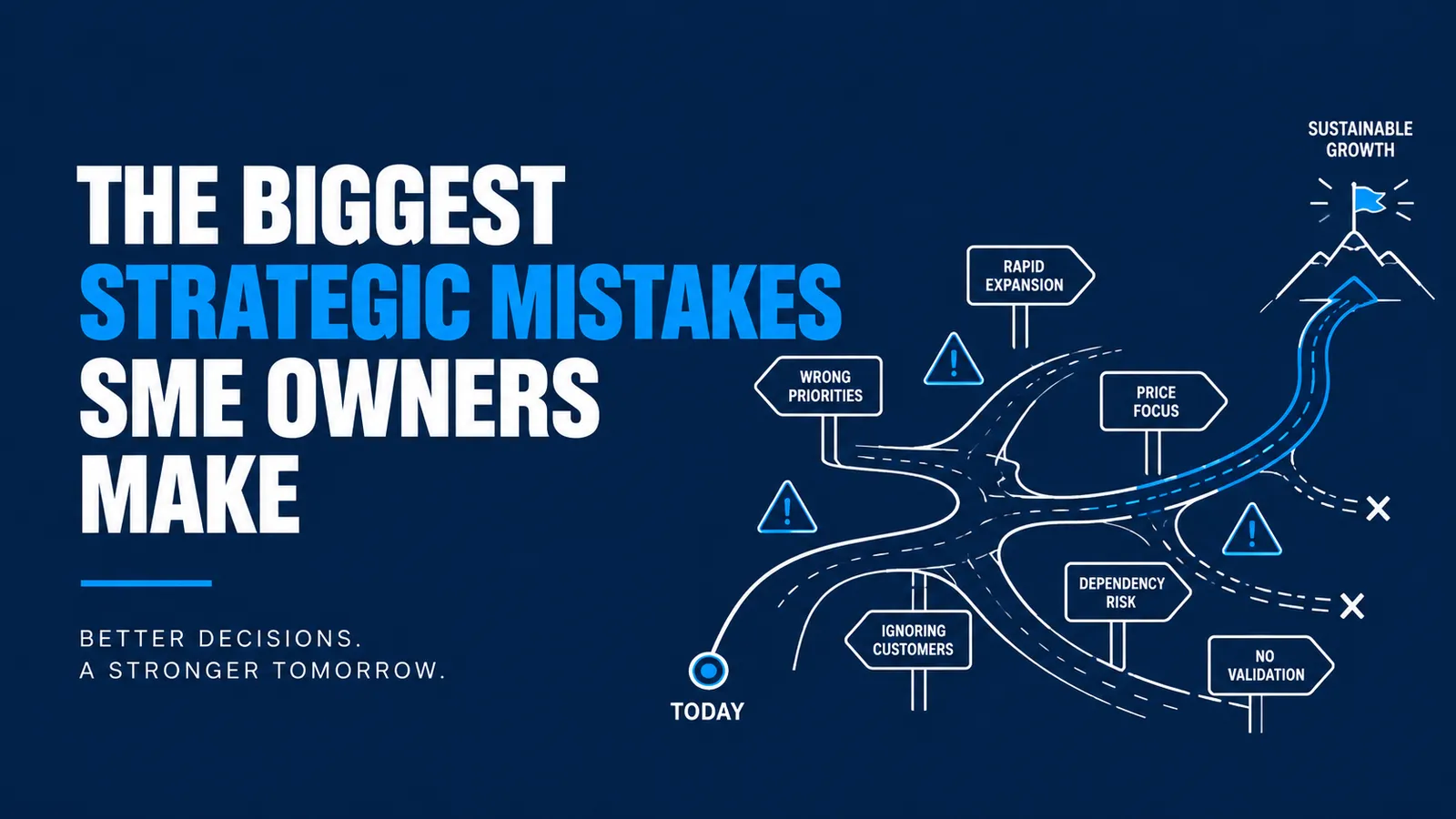
The Biggest Strategic Mistakes SME Owners Make
By the Rytmove Team · 21 Sept 2026
Running an SME is challenging.
Every day involves decisions.
Hiring decisions.
Pricing decisions.
Investment decisions.
Product decisions.
Expansion decisions.
Customer decisions.
Most business owners focus heavily on execution.
And rightly so.
Execution keeps the business running.
But strategy determines where the business is heading.
Many SMEs work incredibly hard.
Yet growth remains slow.
Profitability remains inconsistent.
Opportunities are missed.
Often the issue is not effort.
It is strategy.
The most expensive mistakes in business are rarely operational.
They are strategic.
Why Strategic Mistakes Are Dangerous
Operational mistakes are usually visible.
A delayed shipment.
A customer complaint.
A missed deadline.
These problems are obvious and can often be corrected quickly.
Strategic mistakes are different.
They develop slowly.
Their impact compounds over time.
By the time they become visible, the cost is often significant.
That is why strategic clarity is one of the biggest competitive advantages for SMEs.
Mistake #1: Chasing Every Opportunity
Growth creates opportunities.
New customers.
New products.
New markets.
New partnerships.
Many SME owners believe every opportunity should be pursued.
The result is predictable.
Resources become scattered.
Teams lose focus.
Execution quality declines.
Businesses often grow faster when they decide what not to pursue.
Focus creates momentum.
Distraction creates complexity.
Mistake #2: Expanding Before The Business Is Ready
Expansion sounds exciting.
A second city.
A new market.
A larger team.
Additional product lines.
But expansion magnifies existing weaknesses.
If operations are unstable today, expansion often creates bigger problems tomorrow.
Before expanding, businesses should ask:
Is demand proven?
Are operations scalable?
Is profitability healthy?
Can leadership handle additional complexity?
Expansion should be the outcome of strength.
Not the solution to weakness.
Mistake #3: Competing Primarily On Price
Many SMEs attempt to win customers by lowering prices.
Initially, it works.
Sales increase.
Customers arrive.
But over time, problems emerge.
Lower margins create:
Cash flow pressure
Reduced profitability
Limited investment capacity
Higher customer churn
Competing solely on price often becomes a race to the bottom.
Strong businesses compete on value.
Not just cost.
Mistake #4: Ignoring Customer Retention
Most businesses focus on acquiring customers.
Fewer focus on retaining them.
Yet retention is often one of the most powerful growth drivers.
Acquiring a customer is expensive.
Keeping a customer is usually far cheaper.
Questions every SME should ask:
Why do customers stay?
Why do customers leave?
How often do customers return?
Are customers referring others?
Retention frequently creates more growth than acquisition.
Mistake #5: Overdependence On A Single Customer
Many SMEs experience rapid growth because of one large customer.
Initially, this feels positive.
Revenue increases.
Predictability improves.
But concentration risk grows.
If one customer contributes a large percentage of revenue, the business becomes vulnerable.
A contract loss.
A pricing dispute.
A leadership change.
Any of these can create significant disruption.
Diversification reduces risk.
Mistake #6: Building Without Validating
Business owners often invest heavily before validating assumptions.
Launching products.
Expanding services.
Entering markets.
Hiring teams.
The assumption is simple:
"If we build it, customers will come."
Sometimes they do.
Often they do not.
Validation should happen before major investments.
Not after.
Learning is cheaper than rebuilding.
Mistake #7: Delaying Difficult Decisions
Many business challenges become expensive because action is delayed.
Poor performers remain.
Unprofitable products continue.
Weak partnerships survive.
Operational issues linger.
The longer a problem remains unaddressed, the larger it becomes.
Experienced leaders understand that difficult decisions rarely become easier with time.
Mistake #8: Making Decisions In Isolation
Running a business can be lonely.
Many SME owners make critical decisions without external perspectives.
The challenge is simple.
Every leader has blind spots.
Experience helps identify risks that may not be obvious internally.
External perspectives can reveal:
Hidden assumptions
Strategic risks
Growth opportunities
Alternative approaches
Second opinions often prevent expensive mistakes.
Mistake #9: Focusing Only On Revenue
Revenue is important.
But revenue alone can be misleading.
A business can grow revenue while:
Losing money
Increasing complexity
Reducing margins
Creating operational pressure
Strong businesses monitor:
Profitability
Cash flow
Customer retention
Unit economics
Operational efficiency
Revenue is one metric.
Not the entire picture.
Mistake #10: Treating Strategy As A One-Time Activity
Many business owners create a strategy once and rarely revisit it.
Markets evolve.
Customers change.
Competitors improve.
Technology advances.
Strategy must evolve as well.
The strongest SMEs regularly reassess:
Market conditions
Customer needs
Competitive positioning
Growth priorities
Strategic reviews should be ongoing.
Not annual exercises.
What Experienced Operators Do Differently
Experienced operators rarely assume they have all the answers.
Instead, they ask better questions.
They challenge assumptions.
They seek external perspectives.
They focus on fundamentals.
They prioritize long-term value creation.
Most importantly, they recognize patterns.
Many business problems have been solved before.
Learning from those experiences often accelerates better decisions.
Questions Every SME Owner Should Ask
To avoid strategic mistakes, regularly ask:
What assumptions are we making?
What could disrupt our business?
Where are we overly dependent?
What is preventing faster growth?
Are we focused on the right opportunities?
What would an experienced operator challenge about our strategy?
These questions often reveal valuable insights.
Final Thoughts
Most SMEs do not struggle because owners lack commitment.
They struggle because strategic mistakes quietly compound over time.
The good news is that many of these mistakes are preventable.
By focusing on validation, retention, profitability, diversification, and strategic clarity, business owners can significantly improve their chances of long-term success.
Because in business, effort matters.
But direction matters even more.
About Rytmove
Business Challenges. Trusted Second Opinions.
Rytmove helps founders, startup teams, SME owners, and business leaders gain clarity on important business decisions through conversations with experienced operators who have solved similar challenges before.
Whether you're reviewing business strategy, evaluating expansion opportunities, improving profitability, solving growth challenges, or validating major decisions, Rytmove helps you make better decisions with confidence.
Website: https://rytmove.in