Blog
The Cost of Building the Wrong Product
By the Rytmove Team · 20 Sept 2026
Every founder dreams of building the next successful company.
The journey usually begins with an idea.
The idea feels exciting.
The solution feels obvious.
The opportunity appears massive.
The team starts building.
Months pass.
Features get added.
Designs improve.
Development continues.
Then reality arrives.
Customers are not interested.
Adoption remains low.
Revenue never materializes.
What seemed like a great opportunity turns into an expensive lesson.
The harsh truth is that most startups do not fail because they cannot build.
They fail because they build something customers never truly wanted.
Why Founders Build The Wrong Product
Building products has become easier than ever.
Validating products remains difficult.
Many founders make decisions based on assumptions instead of evidence.
Common examples include:
Assuming customers have a problem
Assuming the problem is important
Assuming customers will pay
Assuming users behave in a certain way
Assuming demand exists
Unfortunately, assumptions are not validation.
Markets reward evidence.
Not optimism.
The Hidden Cost Of Wrong Assumptions
Most founders focus on development costs.
But the real cost is much larger.
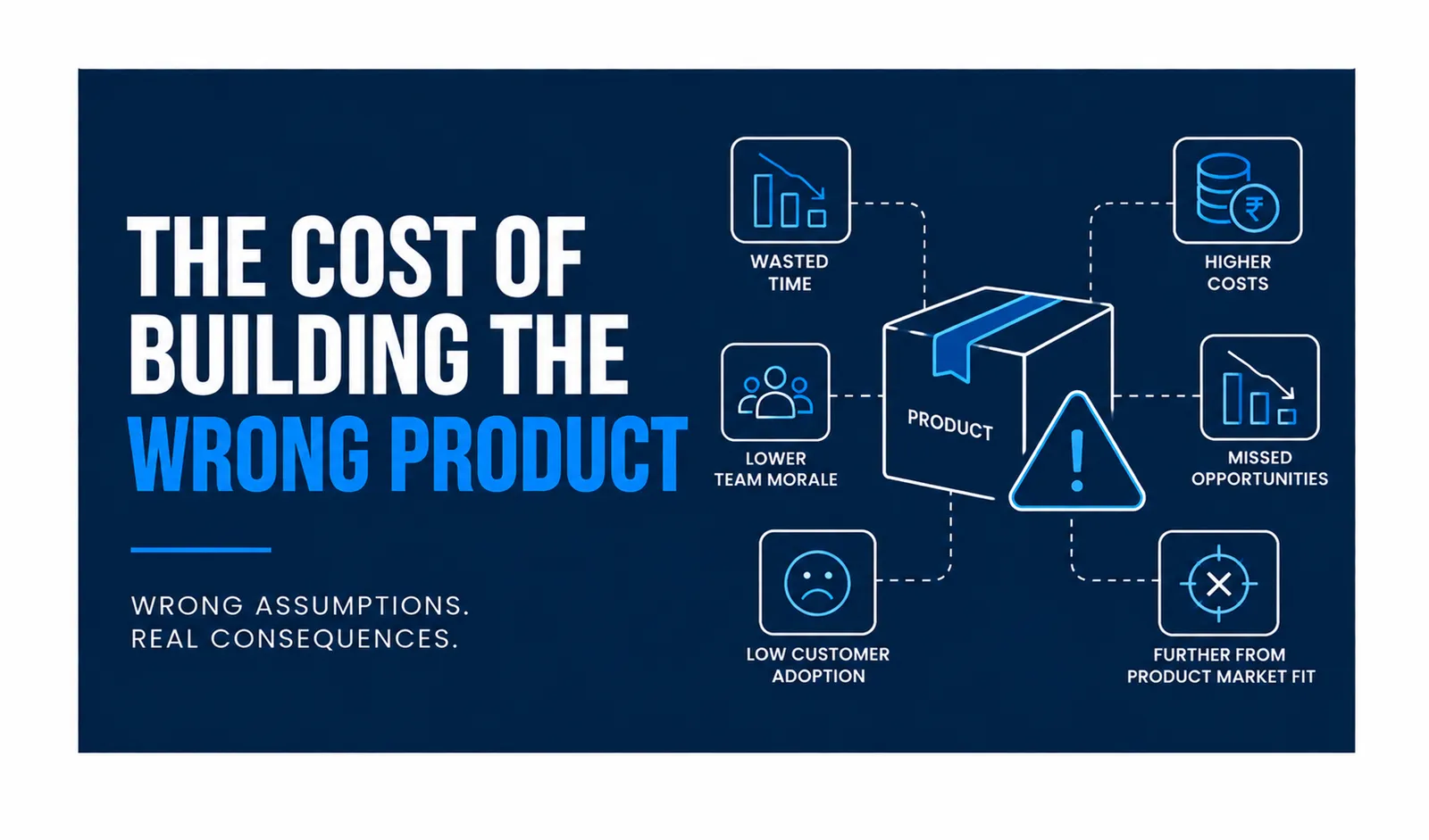
Building the wrong product impacts:
Time
Capital
Team morale
Market opportunities
Founder confidence
Competitive advantage
A startup can recover from a bad feature.
Recovering from two years spent solving the wrong problem is much harder.
Every month invested in the wrong direction is a month not invested in the right one.
Cost #1: Wasted Development Resources
The most obvious cost is engineering effort.
Teams spend months building:
Features nobody uses
Workflows nobody needs
Integrations nobody requests
Dashboards nobody values
Development teams remain busy.
Progress appears visible.
Yet customer value remains absent.
Many startups mistake activity for progress.
Building faster only increases losses if the destination is wrong.
Cost #2: Lost Market Opportunities
Markets move quickly.
Competitors evolve.
Customer needs change.
While founders spend time building the wrong product, opportunities disappear.
Potential customers adopt alternative solutions.
New competitors emerge.
Market dynamics shift.
The opportunity cost can be larger than the actual financial cost.
The biggest loss is often what could have been built instead.
Cost #3: Cash Burn Without Validation
Startups frequently invest in:
Product development
Design
Marketing
Hiring
Infrastructure
Technology
Without validation, these investments become risky.
Founders often believe growth will arrive after one more feature.
One more release.
One more redesign.
One more campaign.
The problem is rarely execution.
The problem is frequently a lack of Product Market Fit.
Money accelerates outcomes.
It does not fix invalid assumptions.
Cost #4: Team Morale Declines
People want to work on products that create impact.
When teams repeatedly launch features that fail to gain traction, motivation suffers.
Questions begin to emerge:
Why are customers not responding?
Why are metrics stagnant?
Why are we building this?
Are we solving the right problem?
Low morale reduces productivity.
Reduced productivity creates more delays.
The cycle becomes difficult to break.
Cost #5: Customer Trust Is Harder To Earn
Customers form opinions quickly.
If early versions fail to solve meaningful problems, convincing customers to return becomes difficult.
Poor first impressions create friction.
Customers remember:
Complex onboarding
Missing value
Weak differentiation
Broken experiences
Building the wrong product not only wastes internal resources but can also damage external credibility.
The Most Common Warning Signs
Many founders ignore signals that the market is providing.
Warning signs include:
Weak customer retention
Low engagement
Limited referrals
Poor conversion rates
Minimal willingness to pay
High customer churn
Low usage frequency
Constant feature requests unrelated to your roadmap
These signals often indicate a deeper problem.
The product may not be solving a high-priority customer need.
Why Customer Feedback Alone Isn't Enough
Founders often hear:
"This is interesting."
"I like the idea."
"This looks useful."
These comments feel encouraging.
But interest does not equal demand.
The real questions are:
Will customers use it?
Will customers pay for it?
Will customers return?
Will customers recommend it?
Behavior matters more than compliments.
The market validates through actions, not words.
How Experienced Founders Reduce Product Risk
Experienced operators rarely start with large investments.
They focus on learning before scaling.
Their process often includes:
Customer interviews
Problem validation
Prototype testing
Landing page experiments
Pilot programs
Small-scale launches
The objective is simple:
Validate assumptions before committing resources.
Every unanswered assumption increases risk.
The Product Validation Questions Every Founder Should Ask
Before investing heavily in development, ask:
Is this a real problem?
How frequently does it occur?
Who experiences it most?
How are customers solving it today?
Are existing solutions inadequate?
Will customers pay for a better solution?
What evidence supports demand?
What assumptions remain untested?
What would cause customers to switch?
How will success be measured?
The quality of these answers often determines startup outcomes.
Product Market Fit Changes Everything
Once Product Market Fit emerges, many startup challenges become easier.
Customers:
Stay longer
Engage more
Refer others
Provide feedback
Pay willingly
Growth becomes more efficient.
Marketing becomes more effective.
Sales become easier.
Without Product Market Fit, every growth initiative feels expensive.
With Product Market Fit, momentum begins to compound.
What Experienced Operators Would Do
Experienced operators understand that building is not the hardest part.
Choosing what to build is.
Before committing significant time, money, or resources, they challenge assumptions.
They seek external perspectives.
They validate customer demand.
They stress-test business ideas.
Most importantly, they ask difficult questions before expensive mistakes occur.
Because preventing a bad decision is often more valuable than fixing one later.
Final Thoughts
The cost of building the wrong product extends far beyond development expenses.
It includes lost time, missed opportunities, declining morale, wasted capital, and slower growth.
The best founders do not obsess over building faster.
They obsess over learning faster.
Before investing heavily in a product, ensure the problem is real, the demand is validated, and customers are willing to pay.
Because building the right product is difficult.
Building the wrong product is expensive.
About Rytmove
Business Challenges. Trusted Second Opinions.
Rytmove helps founders, startup teams, SME owners, and business leaders gain clarity on important business decisions through conversations with experienced operators who have solved similar challenges before.
Whether you're validating a startup idea, assessing Product Market Fit, reviewing pricing strategy, evaluating market expansion, or making critical product decisions, Rytmove helps you make better decisions with confidence.
Website: https://rytmove.in