
Blog
The Difference Between Advice and Expertise
By the Rytmove Team · 23 Sept 2026
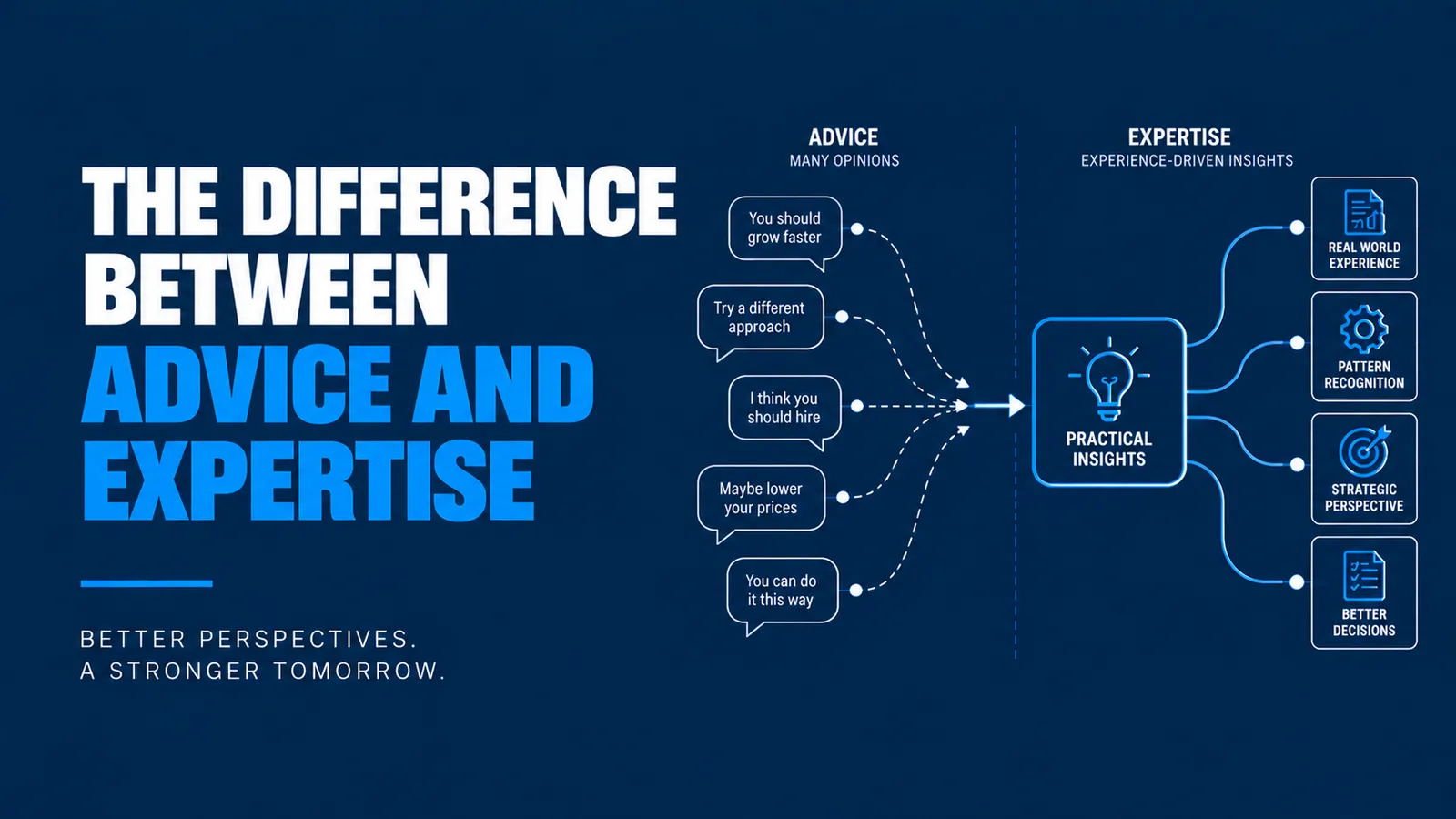
Business leaders receive advice every day.
From colleagues.
Friends.
Investors.
Customers.
Industry peers.
Social media.
Podcasts.
Online communities.
The challenge is not finding advice.
The challenge is knowing which advice deserves attention.
Because advice and expertise are not the same thing.
And understanding the difference can have a significant impact on business outcomes.
Why Advice Is Everywhere
Modern leaders have access to more information than ever before.
Every business problem seems to generate endless opinions.
Should you raise prices?
Expand internationally?
Launch a new product?
Hire aggressively?
Pursue funding?
There is never a shortage of people willing to offer suggestions.
Many of these suggestions are well-intentioned.
Some are useful.
Many are not.
The problem is that advice is often based on opinion.
Expertise is based on experience.
What Is Advice?
Advice is a recommendation.
An opinion.
A suggestion.
A perspective.
Anyone can provide advice.
And sometimes valuable ideas come from unexpected places.
However, advice often lacks context.
The person giving it may not fully understand:
Your business
Your customers
Your industry
Your constraints
Your objectives
Without context, even good advice can be misleading.
What Is Expertise?
Expertise comes from repeated exposure to similar situations.
It is built through experience.
Successes.
Failures.
Lessons learned.
Patterns observed over time.
Experts have often encountered the same challenge multiple times.
They have seen what works.
What fails.
And what creates unintended consequences.
This experience helps them evaluate situations more effectively.
The Difference Between Information And Judgment
Many people possess information.
Far fewer possess judgment.
Judgment is the ability to interpret information correctly.
To understand trade-offs.
To recognize risks.
To evaluate consequences.
Expertise improves judgment because it combines knowledge with experience.
This is why two people can have access to the same information and arrive at very different conclusions.
Why Expertise Matters In Business
Business decisions rarely involve perfect information.
Leaders often make decisions amid uncertainty.
They must balance:
Risk
Opportunity
Timing
Resources
Market conditions
The right answer is not always obvious.
Experienced operators provide value because they have navigated similar uncertainty before.
They can often identify issues that others overlook.
How Experts Think Differently
Experts often approach problems differently from those offering general advice.
They Focus On Context
Generic advice assumes all situations are similar.
Experts understand that context matters.
A strategy that works for one company may fail for another.
Before providing recommendations, experienced operators seek to understand:
Business model
Market dynamics
Customer behavior
Organizational capabilities
Strategic goals
Context shapes decisions.
They Recognize Patterns
Experienced operators often identify patterns quickly.
Because they have seen similar situations before.
What appears unique may actually be a recurring business challenge.
Pattern recognition helps experts:
Spot risks early
Identify common mistakes
Recommend proven approaches
Avoid unnecessary experimentation
They Understand Trade-Offs
Many business decisions involve competing priorities.
Growth versus profitability.
Speed versus quality.
Expansion versus focus.
Cost versus capability.
Experts understand that every decision creates trade-offs.
Rather than looking for perfect solutions, they evaluate consequences.
They Consider Second-Order Effects
Less experienced decision-makers often focus on immediate outcomes.
Experts ask:
"What happens next?"
And then:
"What happens after that?"
They consider:
Operational impact
Financial implications
Customer reactions
Competitive responses
Long-term consequences
This broader perspective improves decision quality.
The Risk Of Following Generic Advice
Generic advice can be dangerous when applied without context.
Consider statements like:
"Raise prices."
"Expand faster."
"Hire aggressively."
"Launch more features."
"Enter new markets."
Each recommendation might be correct.
Or completely wrong.
The answer depends on circumstances.
Expertise helps determine which advice applies and when.
Why Experienced Perspectives Save Time
One of the greatest benefits of expertise is accelerated learning.
Instead of learning solely through trial and error, leaders can learn from those who have already faced similar challenges.
This helps businesses:
Avoid common mistakes
Reduce costly experimentation
Improve execution
Make decisions faster
Increase confidence
Sometimes a single insight can save months of effort.
Questions To Ask Before Accepting Advice
Before acting on any recommendation, consider:
Has this person faced a similar challenge before?
What experience supports their recommendation?
What assumptions are they making?
What context might be missing?
What trade-offs does this advice create?
These questions help separate opinion from expertise.
The Best Leaders Know The Difference
Successful leaders listen broadly.
But they evaluate carefully.
They welcome perspectives from many sources.
Yet they understand that not every opinion deserves equal weight.
The goal is not collecting more advice.
The goal is accessing better expertise.
Because better expertise often leads to better decisions.
Final Thoughts
Advice is easy to find.
Expertise is harder to find.
Advice often reflects opinion.
Expertise reflects experience.
The difference matters.
Especially when important business decisions are involved.
The strongest leaders do not simply seek more opinions.
They seek relevant experience.
Because when uncertainty is high, expertise often becomes one of the most valuable advantages a business can have.
About Rytmove
Business Challenges. Trusted Second Opinions.
Rytmove helps founders, startup teams, SME owners, and business leaders gain clarity on important business decisions through conversations with experienced operators who have solved similar challenges before.
Whether you're evaluating growth opportunities, reviewing strategy, assessing investments, planning expansion, or solving operational challenges, Rytmove helps you access relevant expertise and make better decisions with confidence.
Website: https://rytmove.in