
Blog
The Hidden Cost of Delayed Decisions
By the Rytmove Team · 23 Sept 2026
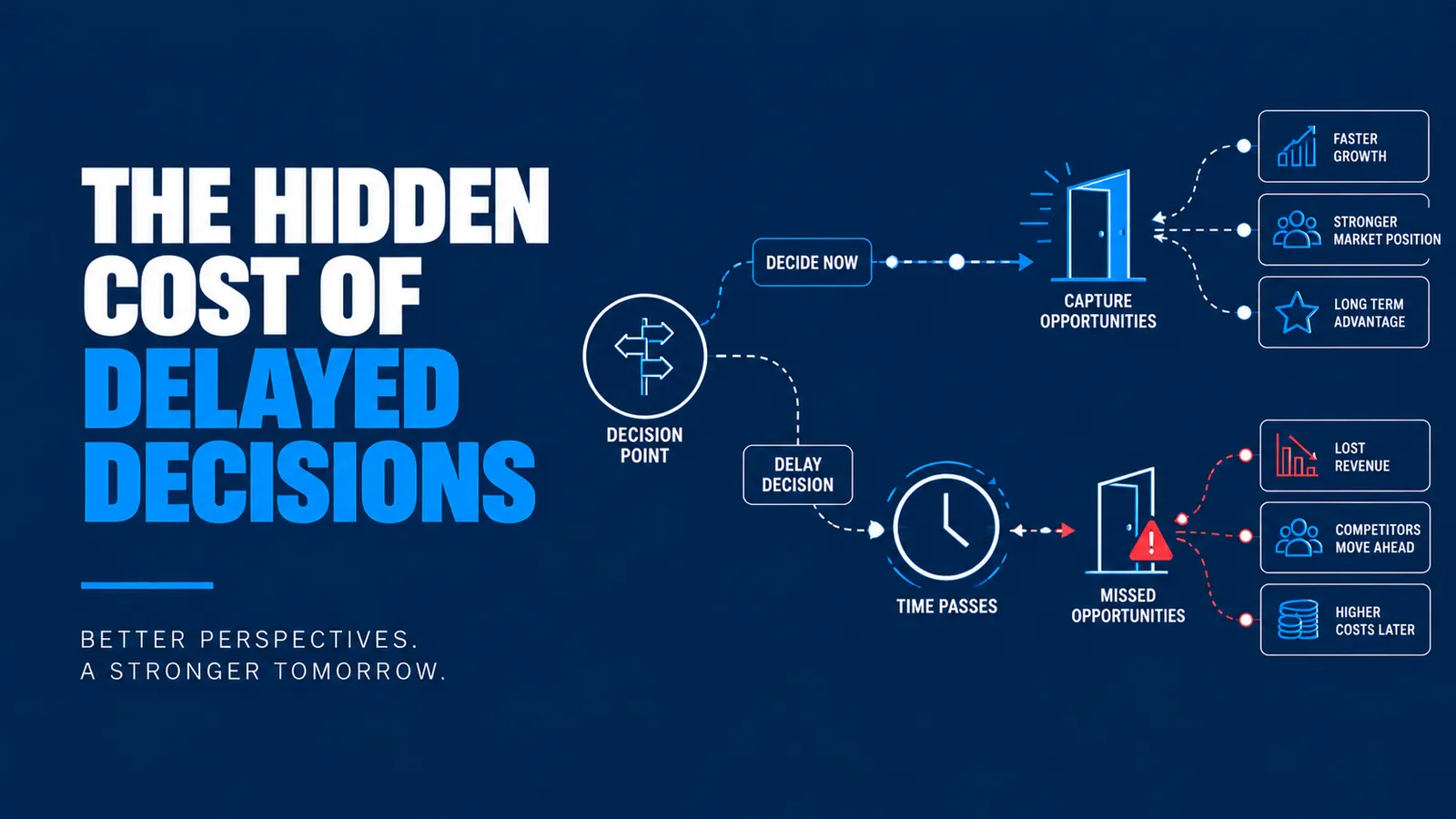
Most leaders spend significant time worrying about making the wrong decision.
Should we enter a new market?
Should we hire now?
Should we raise prices?
Should we launch this product?
Should we invest in growth?
These are important questions.
But many businesses overlook another risk entirely.
The cost of delaying a decision.
In business, indecision is rarely neutral.
While leaders wait for certainty, opportunities continue moving.
Markets evolve.
Competitors act.
Customers change.
And hidden costs begin to accumulate.
Why Leaders Delay Decisions
Most delays are driven by good intentions.
Leaders want:
More data
More certainty
More validation
More stakeholder alignment
Lower risk
These goals are understandable.
The problem is that perfect information rarely exists.
Every business decision involves uncertainty.
Waiting indefinitely often creates new risks rather than eliminating existing ones.
The Illusion Of Certainty
Many leaders believe one more report, one more meeting, or one more month of analysis will make the right answer obvious.
Sometimes additional information helps.
Often it does not.
Business environments change constantly.
By the time perfect clarity arrives, the opportunity may no longer exist.
The pursuit of certainty can become a hidden form of risk avoidance.
And risk avoidance can become expensive.
Opportunity Cost Is Real
Every delayed decision carries an opportunity cost.
While evaluating options, businesses often miss:
New customers
Revenue opportunities
Strategic partnerships
Market share gains
Competitive advantages
These losses rarely appear on financial statements.
Yet they can significantly affect long-term outcomes.
The opportunity not captured today may never return tomorrow.
Markets Do Not Wait
Business operates in dynamic environments.
Customers continue making purchasing decisions.
Competitors continue improving.
Technology continues advancing.
When organizations delay action, competitors often move first.
The company that launches earlier may:
Capture market attention
Build customer relationships
Improve product faster
Strengthen competitive positioning
The cost of delay is often measured by what competitors gain.
Delayed Decisions Create Organizational Friction
Indecision affects more than strategy.
It affects teams.
When major decisions remain unresolved:
Priorities become unclear
Resources remain underutilized
Execution slows
Accountability weakens
Team confidence declines
Employees often spend significant energy waiting for direction.
Momentum suffers.
And organizational effectiveness decreases.
Small Delays Become Large Problems
Many costly business issues begin as small unresolved decisions.
Examples include:
Delaying a key hire
Postponing product improvements
Ignoring customer feedback
Deferring operational upgrades
Waiting too long to adjust pricing
Initially, the impact appears minor.
Over time, the consequences compound.
The longer the delay, the more expensive the solution often becomes.
The Cost Of Delayed Market Entry
One of the clearest examples of decision delay is market expansion.
Businesses often wait for:
Perfect timing
Complete market knowledge
Absolute confidence
Meanwhile competitors continue building relationships and gaining market experience.
The goal is not reckless speed.
The goal is timely action.
Markets reward learning through execution.
Not endless observation.
Why Fast Decisions Are Not Always Better
This is not an argument for impulsive decision-making.
Some decisions deserve careful evaluation.
The objective is not speed alone.
The objective is reducing unnecessary delay.
Strong leaders balance:
Analysis
Experience
Data
Judgment
Timely action
They understand that excessive caution can become its own form of risk.
How Experienced Operators Think About Decisions
Experienced operators rarely seek perfect certainty.
Instead they ask:
What is the downside of acting?
What is the downside of waiting?
What information would materially change the decision?
What assumptions are we making?
What happens if we delay six months?
These questions help evaluate the true cost of inaction.
When Delay Makes Sense
Not every decision should be made immediately.
Delaying can be appropriate when:
Critical information is genuinely missing
Market conditions are unstable
Major risks remain unknown
Significant dependencies exist
The key distinction is intentional delay versus avoidance.
Intentional delay has a clear purpose.
Avoidance usually reflects discomfort with uncertainty.
Questions Leaders Should Ask
When considering whether to delay a decision, ask:
What opportunity might we miss?
What is the cost of waiting?
What information are we hoping to gain?
Will that information materially change the decision?
What happens if we revisit this six months later?
These questions often reveal whether additional delay creates value or simply postpones action.
The Most Expensive Decision
Ironically, some of the most expensive business decisions are never actually made.
They remain stuck in discussions.
Meetings.
Analysis.
Presentations.
And internal debates.
Eventually the market decides instead.
Competitors move.
Customers move.
Opportunities disappear.
The cost becomes visible only after it is too late.
Final Thoughts
Business success rarely comes from perfect decisions.
It comes from making thoughtful decisions and learning quickly.
Most leaders worry about the cost of making the wrong choice.
Far fewer consider the cost of making no choice at all.
Yet delayed decisions often carry hidden costs that compound over time.
Lost opportunities.
Reduced momentum.
Competitive disadvantages.
Missed growth.
Sometimes the biggest risk is not making the wrong decision.
It is waiting too long to make one.
About Rytmove
Business Challenges. Trusted Second Opinions.
Rytmove helps founders, startup teams, SME owners, and business leaders gain clarity on important business decisions through conversations with experienced operators who have solved similar challenges before.
Whether you're evaluating growth opportunities, reviewing strategy, assessing investments, planning expansion, or navigating difficult business decisions, Rytmove helps you move forward with confidence and avoid costly indecision.
Website: https://rytmove.in