
Blog
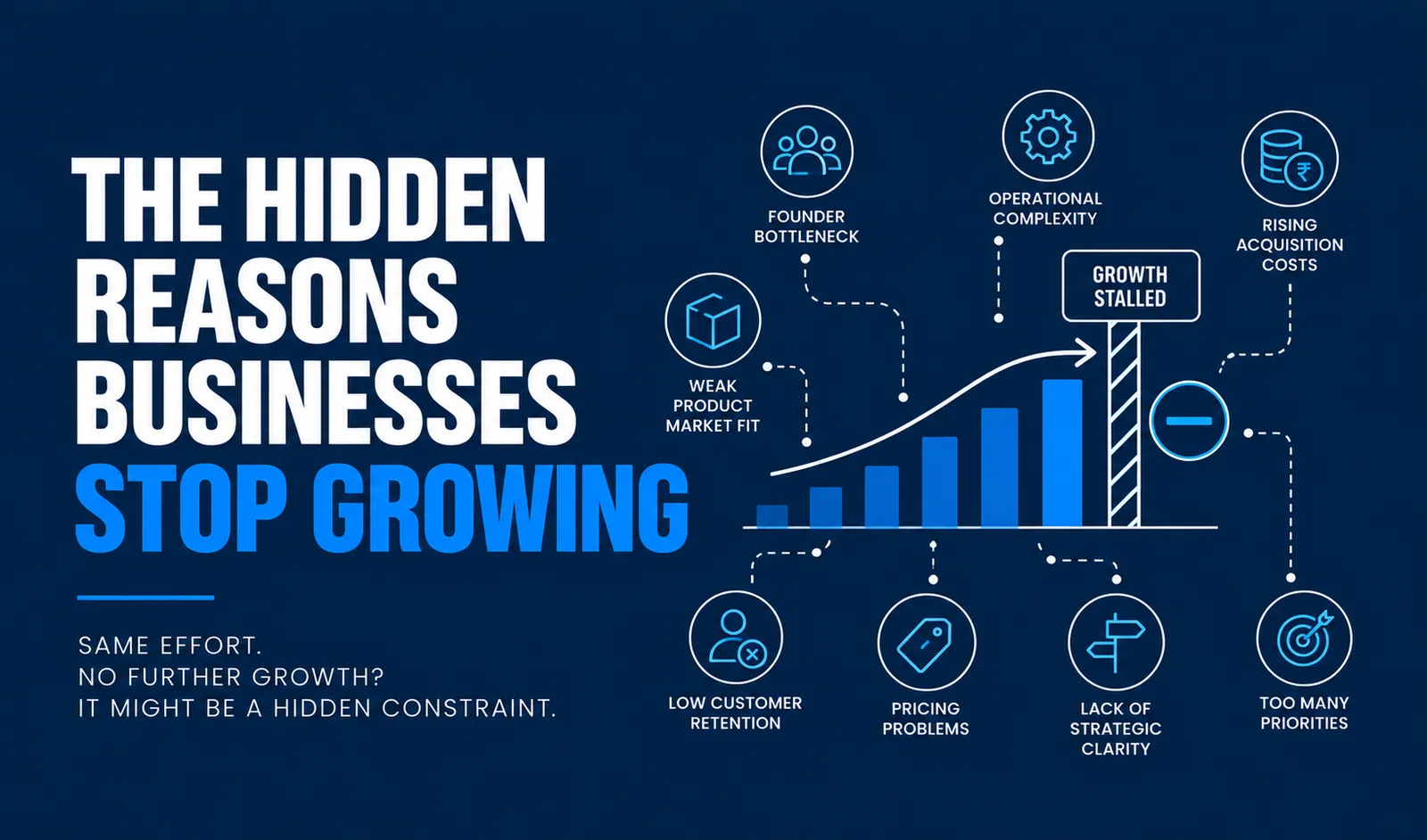
The Hidden Reasons Businesses Stop Growing
By the Rytmove Team · 20 Sept 2026
Every business owner dreams about growth.
More customers.
More revenue.
More market share.
More opportunities.
And for a while, growth often comes naturally.
Early customers arrive.
Revenue increases.
Word-of-mouth spreads.
The business gains momentum.
Then something changes.
Growth slows.
Revenue plateaus.
Customer acquisition becomes harder.
The same strategies that once worked no longer produce results.
Many founders assume the solution is simple.
More marketing.
More sales.
More spending.
More hiring.
But in reality, businesses rarely stop growing because of a single visible problem.
Growth usually stalls because of hidden bottlenecks that have quietly developed over time.
Why Growth Plateaus Happen
Business growth is rarely linear.
Most companies grow in stages.
Each stage introduces new challenges.
What helped a business reach ₹10 lakh in monthly revenue may not help it reach ₹1 crore.
What worked with 10 employees may fail with 100.
Growth creates complexity.
Complexity creates bottlenecks.
And bottlenecks eventually slow growth.
The challenge is identifying the real constraint.
Hidden Reason #1: The Founder Becomes The Bottleneck
In many growing businesses, founders remain involved in everything.
They approve decisions.
Review customer issues.
Manage hiring.
Handle operations.
Oversee strategy.
This works during the early stages.
As the business grows, founder dependency becomes a major constraint.
Teams wait for approvals.
Decisions slow down.
Execution suffers.
Businesses cannot scale efficiently when every important decision flows through one person.
Hidden Reason #2: Product Market Fit Has Weakened
Many businesses achieve initial success and assume Product Market Fit will last forever.
Markets evolve.
Customer expectations change.
Competitors improve.
New technologies emerge.
What solved customer problems two years ago may no longer be enough today.
Signs include:
Declining retention
Lower engagement
Increasing churn
Reduced referrals
Slower conversion rates
Growth often stalls when businesses stop adapting to changing customer needs.
Hidden Reason #3: Customer Acquisition Costs Are Rising
Many businesses rely heavily on paid marketing.
Initially, results look impressive.
Customers arrive quickly.
Revenue grows.
Over time, acquisition costs often increase.
Competition intensifies.
Advertising platforms become more expensive.
Conversion rates decline.
Businesses that depend entirely on paid acquisition eventually face diminishing returns.
Sustainable growth requires multiple customer acquisition channels.
Hidden Reason #4: Operational Complexity Is Increasing
As businesses grow, operations become more difficult.
Processes that once felt simple become complicated.
Teams expand.
Customers increase.
Transactions multiply.
Manual systems begin breaking.
Common symptoms include:
Delayed deliveries
Customer complaints
Process errors
Internal confusion
Lower productivity
Operational inefficiencies often remain hidden until growth begins to slow.
Hidden Reason #5: Too Many Priorities
Growth often creates new opportunities.
New products.
New markets.
New partnerships.
New customer segments.
Many businesses attempt to pursue everything simultaneously.
Focus disappears.
Resources become fragmented.
Execution quality declines.
The result is activity without progress.
Successful businesses understand that growth requires focus as much as ambition.
Hidden Reason #6: Weak Leadership Capacity
Business growth requires leadership growth.
The skills needed to build a small company differ significantly from the skills needed to scale one.
Founders often struggle with:
Delegation
Team management
Strategic planning
Organizational design
Leadership development
When leadership capability fails to keep pace with company growth, expansion slows.
Hidden Reason #7: Customers Are Not Staying
Many businesses focus heavily on acquiring customers.
Fewer focus on retaining them.
Retention is often a stronger indicator of business health than acquisition.
Questions worth asking include:
Are customers returning?
Are they renewing?
Are they increasing usage?
Are they referring others?
Growth becomes expensive when businesses constantly replace customers who leave.
Hidden Reason #8: Pricing Problems
Pricing issues quietly limit growth.
Businesses frequently:
Underprice products
Over-discount services
Compete primarily on cost
Ignore customer willingness to pay
Poor pricing reduces profitability.
Reduced profitability limits reinvestment.
Limited reinvestment restricts growth.
Pricing is often one of the most overlooked growth levers.
Hidden Reason #9: Lack Of Strategic Clarity
Many businesses become busy but directionless.
Teams work hard.
Projects continue.
Meetings increase.
Yet nobody can clearly answer:
What is our biggest opportunity?
What is our competitive advantage?
Which customer segment matters most?
What should we stop doing?
Without strategic clarity, resources are spread too thinly.
Growth loses momentum.
Hidden Reason #10: Success Creates Complacency
Ironically, past success can become a future problem.
Businesses that grow quickly often become comfortable.
Innovation slows.
Customer feedback receives less attention.
Processes become rigid.
Competitors gain ground.
Markets reward continuous improvement.
Not past achievements.
The companies that continue growing are often the ones that remain curious and adaptable.
How Experienced Operators Identify Growth Bottlenecks
Experienced business leaders rarely assume growth problems are caused by a lack of effort.
Instead, they search for constraints.
They ask:
What is limiting growth today?
What would happen if demand doubled tomorrow?
Which process would break first?
Where are customers dropping off?
Which decisions take too long?
Growth bottlenecks are often easier to solve once they become visible.
The challenge is recognizing them early.
Questions Every Business Leader Should Ask
If growth has slowed, consider asking:
Has customer behavior changed?
Is our value proposition still relevant?
Are we overly dependent on one acquisition channel?
What operational challenges are emerging?
Is leadership scaling with the business?
Are customers staying and referring others?
What is our biggest constraint right now?
These questions frequently reveal the true source of stalled growth.
Growth Requires More Than Effort
Many founders respond to slowing growth by working harder.
Longer hours.
More meetings.
More activity.
But growth problems are rarely solved by effort alone.
They are solved through better decisions.
Better systems.
Better focus.
And a clearer understanding of the constraints limiting progress.
Final Thoughts
Businesses rarely stop growing without a reason.
The cause is often hidden beneath the surface.
Operational bottlenecks.
Leadership challenges.
Customer retention issues.
Pricing problems.
Strategic confusion.
Founder dependency.
The businesses that continue growing are not necessarily the hardest working.
They are the ones that identify and remove constraints before those constraints become growth killers.
Because sustainable growth is not about doing more.
It is about understanding what is holding you back.
About Rytmove
Business Challenges. Trusted Second Opinions.
Rytmove helps founders, startup teams, SME owners, and business leaders gain clarity on important business decisions through conversations with experienced operators who have solved similar challenges before.
Whether you're diagnosing stalled growth, improving Product Market Fit, reviewing pricing strategy, scaling operations, or evaluating expansion opportunities, Rytmove helps you make better decisions with confidence.
Website: https://rytmove.in