
Blog
The Most Expensive Assumption in Business
By the Rytmove Team · 23 Sept 2026
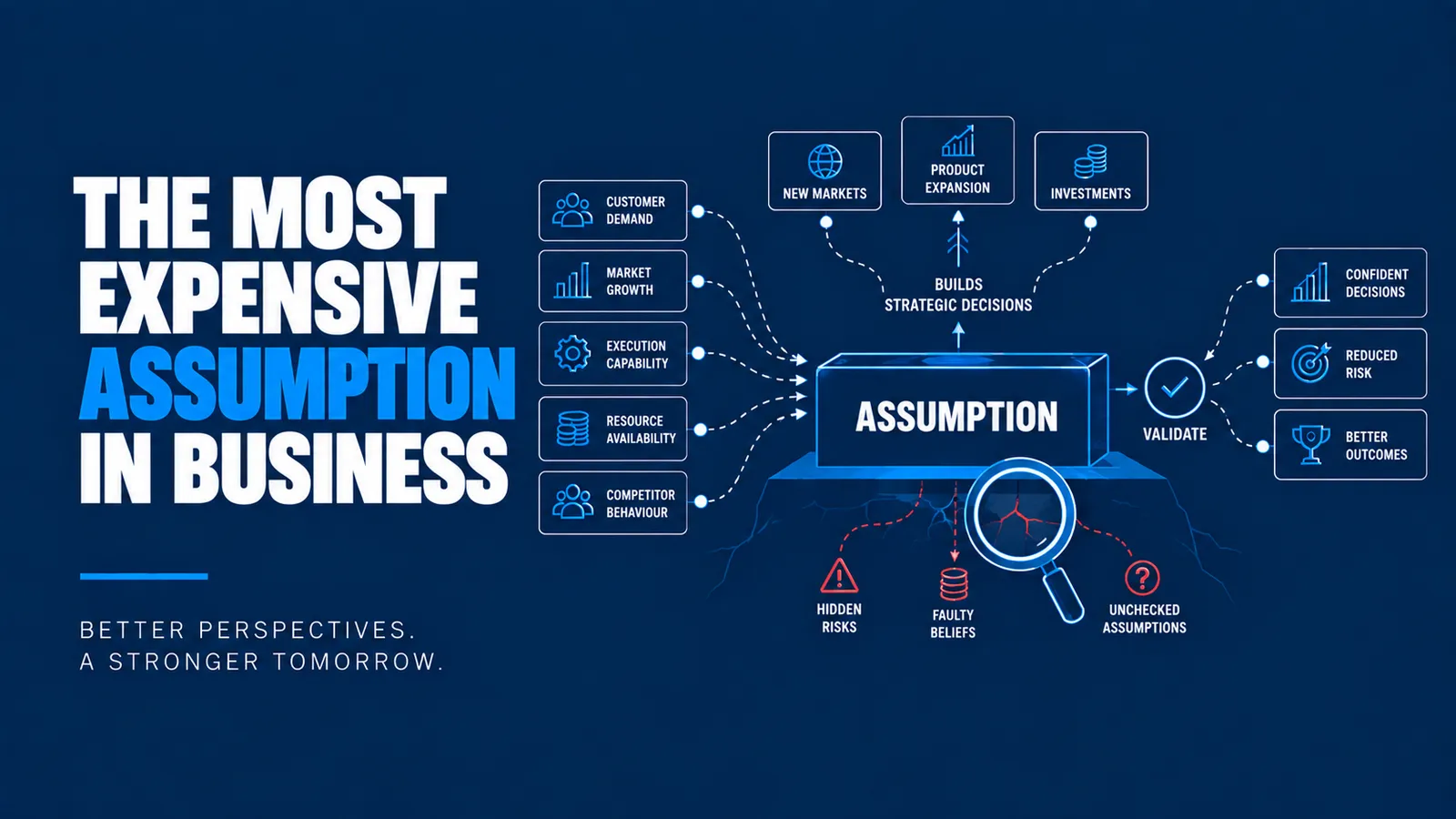
Every business decision is built on assumptions.
Customers will buy.
The market will grow.
The product will succeed.
The team can execute.
Competitors will respond predictably.
Most of the time, leaders don't consciously think about these assumptions.
They simply accept them as true.
And that is where problems begin.
Because some of the most expensive business mistakes are not caused by poor execution.
They are caused by incorrect assumptions.
Why Assumptions Matter
Business decisions are made under uncertainty.
No leader has perfect information.
No company can predict the future with complete accuracy.
As a result, assumptions become necessary.
The challenge is that assumptions often feel like facts.
Especially when they are repeated frequently.
Or widely accepted internally.
Or supported by limited evidence.
The more confident an organization becomes in an assumption, the more dangerous it can become.
The Most Expensive Assumption
Perhaps the most expensive assumption in business is:
"We already know the answer."
This assumption prevents curiosity.
Prevents validation.
Prevents learning.
And often prevents leaders from seeing risks that are hiding in plain sight.
Organizations become convinced they understand:
Their customers
Their market
Their competitors
Their product
Their growth strategy
Until reality proves otherwise.
Assumptions About Customers
Many businesses assume they understand customer needs.
Examples include:
Customers want more features
Customers care most about price
Customers understand our value proposition
Customers will behave as expected
These assumptions often go untested.
Yet customer behavior frequently reveals a different reality.
The businesses that succeed continue validating customer assumptions rather than relying on past beliefs.
Assumptions About Growth
Growth assumptions are particularly dangerous.
Businesses often assume:
Demand will continue increasing
Marketing channels will remain effective
Customer acquisition costs will stay stable
Existing strategies will continue working
But markets evolve.
Customer expectations change.
Competition increases.
Growth rarely follows a straight line.
What worked yesterday may not work tomorrow.
Assumptions About Execution
Leaders frequently underestimate execution complexity.
Common assumptions include:
The team can handle additional workload
New initiatives will launch on time
Operational systems will scale easily
Resources are sufficient
These assumptions often appear reasonable.
Until implementation begins.
Execution challenges have derailed countless business plans.
Why Assumptions Become Invisible
The most dangerous assumptions are the ones nobody notices.
Over time, assumptions become embedded in:
Strategy discussions
Financial models
Growth plans
Product roadmaps
Internal narratives
Eventually they stop being questioned.
They become accepted truth.
And accepted truth rarely receives scrutiny.
Confirmation Bias Makes Assumptions Worse
People naturally seek evidence that supports existing beliefs.
This is known as confirmation bias.
Organizations often:
Highlight supporting evidence
Ignore contradictory signals
Dismiss alternative viewpoints
Reinforce existing narratives
As a result, weak assumptions can survive much longer than they should.
Why External Perspectives Matter
One of the most effective ways to identify assumptions is through external perspective.
Someone outside the organization often asks questions such as:
Why do you believe this?
What evidence supports it?
What if the opposite were true?
What assumptions drive this strategy?
These questions may seem simple.
But they often reveal significant blind spots.
The Cost Of Unchallenged Assumptions
Incorrect assumptions can create:
Failed product launches
Poor investments
Hiring mistakes
Pricing errors
Market expansion failures
Strategic misalignment
The financial cost can be substantial.
But the opportunity cost is often even greater.
Lost time.
Lost momentum.
Lost opportunities.
Lost growth.
How Experienced Operators Test Assumptions
Experienced operators rarely accept assumptions at face value.
Instead they ask:
What evidence supports this?
What assumptions are driving this conclusion?
What could make us wrong?
What would invalidate this belief?
What are we not seeing?
This process improves decision quality and reduces unnecessary risk.
Questions Every Leader Should Ask
Before making a major decision, ask:
What assumptions are we making?
Which assumptions matter most?
What evidence supports them?
Which assumptions remain untested?
What happens if these assumptions are wrong?
The answers often reveal important risks that were previously hidden.
Final Thoughts
Business success is rarely determined by perfect information.
It is often determined by the quality of assumptions.
The most expensive mistakes usually begin long before execution.
They begin when assumptions go unchallenged.
Strong leaders understand this.
They continuously test beliefs.
Seek alternative perspectives.
Challenge conventional thinking.
And validate what others simply accept.
Because in business, what you assume can be just as important as what you know.
About Rytmove
Business Challenges. Trusted Second Opinions.
Rytmove helps founders, startup teams, SME owners, and business leaders gain clarity on important business decisions through conversations with experienced operators who have solved similar challenges before.
Whether you're evaluating strategy, validating assumptions, assessing growth opportunities, reviewing investments, or navigating uncertainty, Rytmove helps you challenge assumptions and make better decisions with confidence.
Website: https://rytmove.in