
Blog
When Should a Founder Pivot?
By the Rytmove Team · 20 Sept 2026
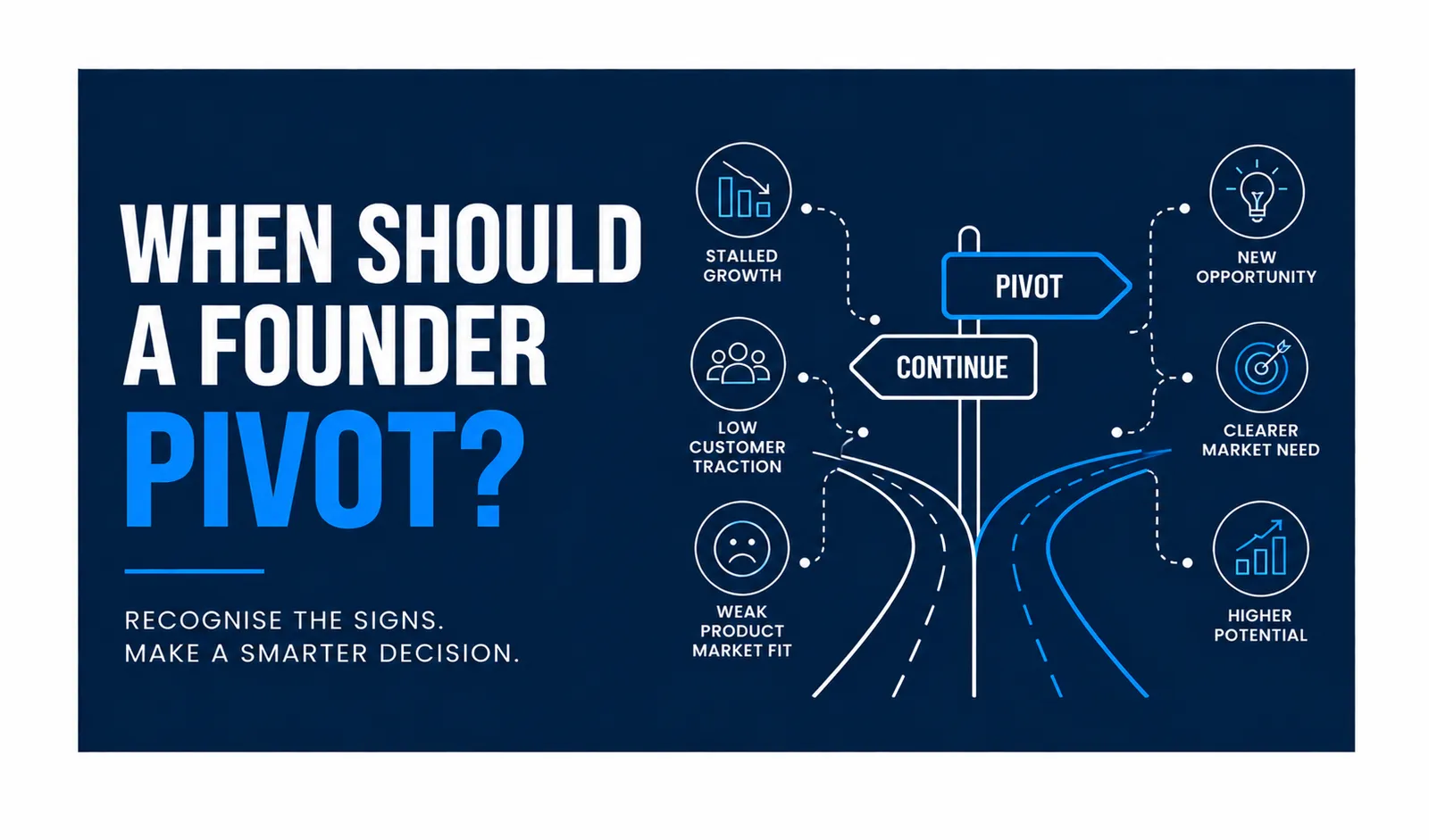
Every founder starts with conviction.
You believe in the problem.
You believe in the solution.
You believe customers will eventually see the value.
That belief is necessary.
Without it, no startup would survive its first year.
But there comes a point when founders must ask a difficult question:
"Are we facing temporary challenges, or are we pursuing the wrong path?"
The answer is rarely obvious.
Many startups fail because they pivot too early.
Many others fail because they never pivot at all.
The most successful founders learn how to distinguish between normal startup struggles and signals that the business needs a new direction.
What Does It Mean To Pivot?
A pivot is a deliberate change in strategy based on new learning.
It is not giving up.
It is not abandoning the mission.
It is not starting over.
A pivot means changing a key assumption about the business while continuing to pursue the broader opportunity.
Examples include:
Targeting a different customer segment
Solving a different problem
Changing the pricing model
Repositioning the product
Focusing on a different use case
Switching distribution channels
The goal is simple:
Find a path that the market wants.
Why Founders Struggle To Pivot
Founders naturally become attached to their ideas.
After months or years of effort, changing direction can feel like admitting failure.
This creates a dangerous bias.
Founders start defending assumptions instead of testing them.
They explain away negative signals.
They focus on isolated successes while ignoring broader trends.
The market, however, remains objective.
Customers either find value or they don't.
The sooner founders accept this reality, the faster they can make better decisions.
Sign #1: Customer Retention Remains Consistently Weak
Customer acquisition can create excitement.
Customer retention reveals the truth.
Ask yourself:
Are users returning after the first experience?
Are customers using the product regularly?
Does engagement improve over time?
If customers repeatedly leave despite product improvements, the problem may be deeper than features or user experience.
Weak retention often indicates that the problem being solved is not important enough.
Or that the solution is not compelling enough.
Sign #2: Customers Like The Product But Won't Pay
This is one of the most dangerous startup signals.
Founders hear:
"This is interesting."
"I would definitely use this."
"Great idea."
Yet conversions remain low.
Customers compliment the product but refuse to spend money.
Positive feedback without purchasing behavior is not validation.
If customers consistently avoid paying, founders should investigate whether they are solving a real business problem or simply creating something that is "nice to have."
Sign #3: Growth Has Stalled For An Extended Period
Every startup experiences plateaus.
A difficult month is not a reason to pivot.
But if growth remains stagnant despite consistent execution, experimentation, and learning, something may be fundamentally wrong.
Questions worth asking:
Are customer acquisition costs increasing?
Are conversion rates improving?
Are referrals growing?
Is engagement strengthening?
If meaningful metrics remain flat for months, the core assumptions behind the business may need reevaluation.
Sign #4: Customers Use The Product Differently Than Expected
Sometimes customers reveal opportunities founders never considered.
You build one solution.
Customers repeatedly use a completely different feature.
You market one use case.
Customers discover another.
These situations deserve attention.
Many successful startups became successful because founders followed customer behavior rather than their original vision.
The market often knows where value exists before the founder does.
Sign #5: Product Market Fit Still Feels Distant
Most startup challenges eventually connect to Product Market Fit.
Warning signs include:
High customer churn
Weak retention
Limited referrals
Poor engagement
Low willingness to pay
Heavy dependence on paid marketing
If these issues persist despite continuous improvements, founders should consider whether the business is targeting the wrong market, solving the wrong problem, or delivering the wrong solution.
Sign #6: A Different Customer Segment Shows Stronger Demand
Founders often assume their original target audience is correct.
Sometimes it isn't.
You may discover:
Enterprises value the product more than startups
Mid-sized businesses convert faster than large organizations
International customers respond better than domestic customers
One industry adopts faster than another
When a different customer segment consistently shows stronger demand, it may be worth pivoting toward that opportunity.
When You Should NOT Pivot
Not every challenge requires a strategic shift.
Founders should avoid pivoting simply because:
✗ Growth slowed temporarily
✗ A competitor raised funding
✗ One investor rejected the idea
✗ One customer complained
✗ The startup journey feels difficult
Execution problems often look like strategy problems.
Before pivoting, ensure that issues related to sales, marketing, onboarding, pricing, or positioning have been properly addressed.
A Practical Pivot Decision Framework
Before making a major change, ask these questions:
Have we spoken to enough customers?
What assumptions have been proven wrong?
What assumptions still remain untested?
Are customers receiving meaningful value?
Have we experimented sufficiently?
What does retention data tell us?
What does revenue data tell us?
What patterns appear across customer feedback?
What would we do differently if we started today?
Does the evidence support staying the course?
The stronger the evidence, the easier the decision becomes.
Common Types Of Startup Pivots
Most founders do not need to rebuild everything.
Successful pivots often involve changing a single major variable.
Examples include:
Customer Segment Pivot
Same product, different audience.
Problem Pivot
Same audience, different problem.
Product Pivot
Different solution to the same problem.
Business Model Pivot
Different monetization approach.
Channel Pivot
Different acquisition strategy.
The objective is not to throw away learning.
The objective is to build on it.
What Experienced Operators Do Before Pivoting
Experienced founders rarely make major decisions in isolation.
Before changing direction, they seek external perspectives.
They review:
Customer interviews
Retention metrics
Revenue trends
Market dynamics
Competitive positioning
User behavior patterns
Most importantly, they challenge their assumptions.
Because the closer you are to a problem, the harder it becomes to see it objectively.
A trusted second opinion often reveals blind spots that internal teams miss.
Questions To Ask Before You Pivot
Before making the final decision, answer these questions honestly:
Are customers staying?
Are customers paying?
Are customers returning?
Are customers referring others?
Is demand increasing naturally?
Is the market validating our assumptions?
Are we solving an important problem?
Are we solving it better than alternatives?
The answers usually point toward the right path.
Final Thoughts
Pivoting is not a sign of failure.
It is a sign of learning.
The best founders are not the ones who stubbornly follow the original plan.
They are the ones who adapt when the evidence changes.
If customers are not staying, paying, engaging, or recommending your product, it may be time to reassess your direction.
Not because your vision is wrong.
But because the path to achieving it may be different than you originally imagined.
The goal is not to prove yourself right.
The goal is to build something customers truly want.
About Rytmove
Business Challenges. Trusted Second Opinions.
Rytmove helps founders, startup teams, SME owners, and business leaders gain clarity on important business decisions through conversations with experienced operators who have solved similar challenges before.
Whether you're evaluating Product Market Fit, considering a startup pivot, validating a business idea, reviewing pricing strategy, or planning growth initiatives, Rytmove helps you make better decisions with confidence.
Website: https://rytmove.in