
Blog
Why Data Alone Doesn't Make Better Decisions
By the Rytmove Team · 23 Sept 2026
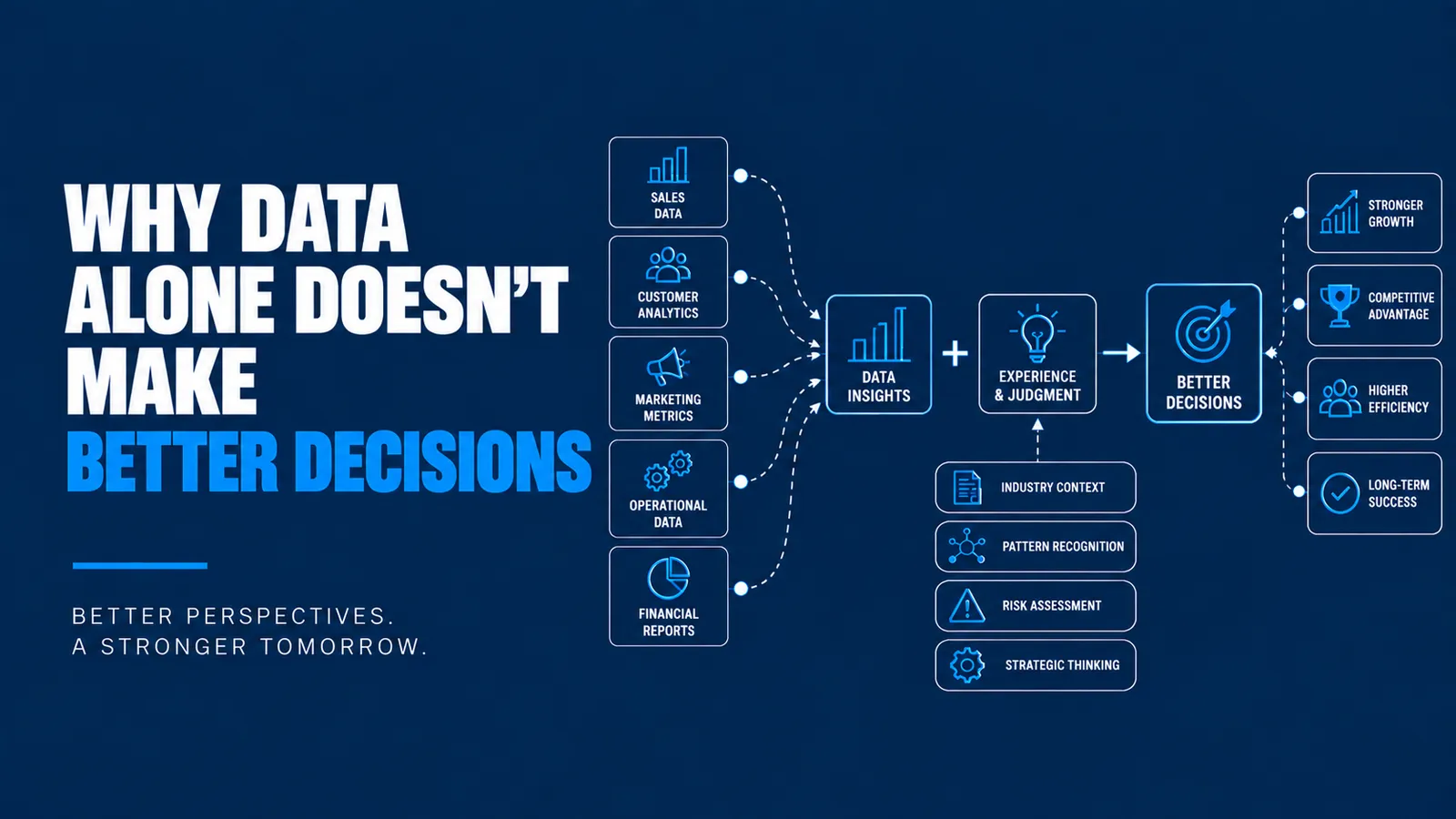
Businesses today have access to more data than at any point in history.
Customer analytics.
Revenue dashboards.
Marketing reports.
Operational metrics.
Financial forecasts.
Real-time tracking systems.
Every click, transaction, and interaction can be measured.
Yet despite this abundance of information, organizations still make poor decisions.
Because data alone is not enough.
Better decisions require something more.
Judgment.
The Data Explosion
Over the past decade, businesses have invested heavily in data collection.
Most organizations can now track:
Customer acquisition
Customer retention
Revenue performance
Product usage
Marketing effectiveness
Operational efficiency
The assumption is simple:
More data leads to better decisions.
Unfortunately, reality is more complicated.
Information Is Not Insight
Data provides information.
Insight provides understanding.
These are not the same thing.
Two organizations can have access to identical data and arrive at completely different conclusions.
Why?
Because data does not explain itself.
People interpret it.
And interpretation introduces judgment.
The Problem With Raw Numbers
Numbers rarely tell the full story.
For example:
Customer retention falls.
Revenue increases.
Website traffic declines.
Conversion rates improve.
Each metric may appear meaningful.
But without context, the significance remains unclear.
The real question is not:
"What does the data say?"
The real question is:
"What does the data mean?"
Data Often Creates False Confidence
One of the biggest risks of modern analytics is false certainty.
Dashboards look precise.
Charts look authoritative.
Metrics appear objective.
But many important business decisions involve uncertainty.
Data can help reduce uncertainty.
It rarely eliminates it.
Leaders sometimes mistake measurement for understanding.
And that can be dangerous.
Correlation Is Not Causation
Businesses frequently confuse correlation with causation.
Two events happen together.
A metric changes.
A trend appears.
The temptation is to assume one caused the other.
But reality is often more complex.
Without careful analysis, organizations can:
Solve the wrong problem
Invest in ineffective initiatives
Misinterpret customer behavior
Draw incorrect conclusions
Good decisions require understanding causes, not just observing patterns.
Data Cannot Replace Context
Context explains why something happens.
Data only shows what happened.
Consider a revenue decline.
The numbers may show:
Lower sales
Reduced traffic
Falling conversions
But they do not explain:
Competitive changes
Customer sentiment
Operational issues
Market conditions
Strategic mistakes
Context transforms information into insight.
Experience Improves Interpretation
Experienced operators often see things that dashboards cannot reveal.
Because they understand:
Industry dynamics
Customer behavior
Operational realities
Historical patterns
Strategic trade-offs
Experience helps leaders interpret data correctly.
This is why expertise remains valuable even in highly data-driven organizations.
Metrics Can Create Blind Spots
Organizations sometimes become overly focused on measurable outcomes.
They optimize:
Conversion rates
Customer acquisition costs
Utilization metrics
Revenue targets
These metrics matter.
But not everything valuable can be measured easily.
Examples include:
Customer trust
Brand perception
Team morale
Strategic flexibility
Long-term positioning
Over-reliance on metrics can create blind spots.
Better Decisions Require Better Questions
Many leaders focus on finding answers.
Experienced operators focus on asking better questions.
Questions such as:
What assumptions exist behind this data?
What information is missing?
What alternative explanations exist?
What would make this conclusion wrong?
What risks are not visible in the dashboard?
These questions often reveal deeper insights.
Why Human Judgment Still Matters
Artificial intelligence.
Predictive analytics.
Machine learning.
Advanced dashboards.
All provide valuable capabilities.
But ultimately business decisions remain human decisions.
Leaders must evaluate:
Risk
Trade-offs
Timing
Strategic priorities
Long-term consequences
These decisions require judgment.
And judgment cannot be fully automated.
What Experienced Leaders Do Differently
Experienced leaders rarely rely on data alone.
Instead they combine:
Data
Context
Experience
External perspectives
Strategic thinking
This balanced approach produces better outcomes.
Data becomes one input.
Not the entire decision.
Questions Leaders Should Ask
Before making an important decision, ask:
What does the data show?
What does the data not show?
What assumptions are influencing interpretation?
What context might be missing?
What alternative explanations exist?
These questions help prevent overconfidence and improve decision quality.
Final Thoughts
Data is incredibly valuable.
But data alone does not create better decisions.
It must be interpreted.
Questioned.
Contextualized.
And combined with experience.
The strongest organizations do not simply collect more data.
They develop better judgment.
Because business success is not determined by who has the most information.
It is determined by who understands it best.
About Rytmove
Business Challenges. Trusted Second Opinions.
Rytmove helps founders, startup teams, SME owners, and business leaders gain clarity on important business decisions through conversations with experienced operators who have solved similar challenges before.
Whether you're evaluating growth opportunities, reviewing strategy, assessing investments, interpreting business data, or navigating uncertainty, Rytmove helps you combine insights with experience and make better decisions with confidence.
Website: https://rytmove.in