
Blog
Why Most Startup Ideas Fail Before They Launch
By the Rytmove Team · 20 Sept 2026
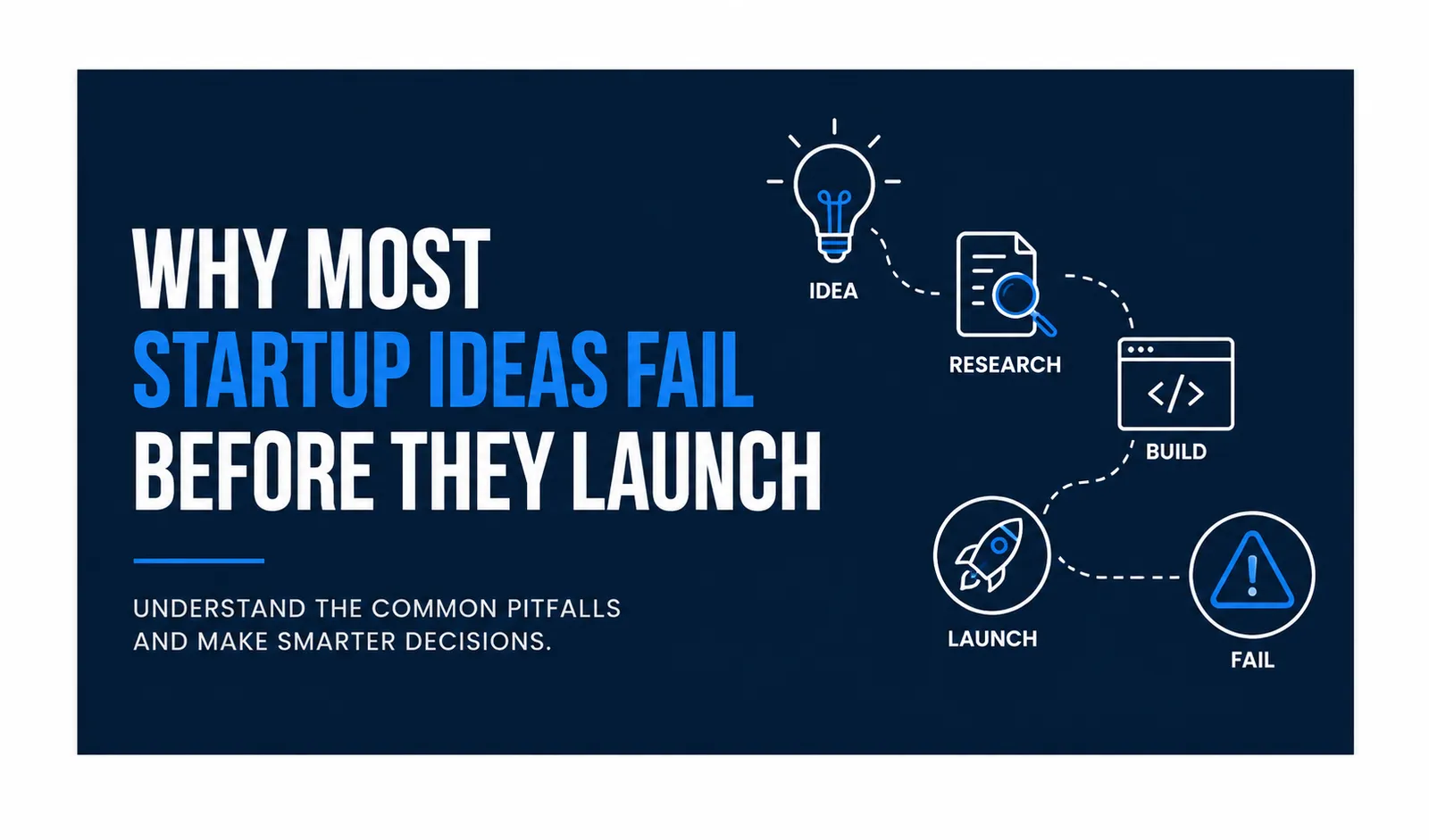
Startup failure rarely begins after launch. It usually starts much earlier.
Many aspiring founders believe startups fail because of poor execution.
Others blame competition.
Some point to funding challenges.
While these factors certainly matter, most startup failures begin before customers ever see the product.
The uncomfortable reality is that many startups spend months building solutions without validating whether the problem is important enough to solve.
The result?
Months of work.
Lakhs of rupees invested.
A product launch.
And little to no customer interest.
The good news is that most of these failures are preventable.
Understanding why startup ideas fail before launch can dramatically improve your chances of building something customers genuinely want.
Founders Fall in Love With Solutions Instead of Problems
One of the biggest startup mistakes is becoming emotionally attached to an idea.
Founders often start with:
"I have a great product idea."
Experienced entrepreneurs start with:
"I have identified a meaningful problem."
This difference matters.
Customers rarely care about products.
They care about solving problems.
If the problem isn't painful enough, even the most innovative solution will struggle to gain traction.
Successful startups begin by understanding customer pain points before designing solutions.
Lack of Startup Validation
Many startup ideas fail because they were never properly validated.
Validation means gathering evidence that customers actually need your solution.
Unfortunately, many founders validate by asking friends and family:
"Would you use this?"
Most people respond positively.
That doesn't mean they will pay for it.
True startup validation involves:
Customer interviews
Market research
Landing page tests
Pilot programs
Pre-orders
Early commitments
Without validation, founders are often building based on assumptions rather than evidence.
Solving Problems That Aren't Important Enough
Not every problem deserves a startup.
Some problems are merely inconveniences.
Others create genuine frustration, financial loss, or operational inefficiency.
Customers pay to solve important problems.
They rarely pay to solve minor annoyances.
Before launching a startup, ask:
What happens if customers do nothing?
If the answer is:
"Not much."
You may not have a business opportunity.
Strong businesses solve meaningful problems with measurable impact.
Building Before Understanding Customers
Many founders spend months building products before speaking with potential users.
This approach creates risk.
Customers often behave differently than founders expect.
What seems obvious internally may not matter externally.
The best founders spend significant time understanding:
Customer behaviour
Existing alternatives
Purchasing decisions
Pain points
Market expectations
Customer understanding should come before product development.
Not after.
Assuming Demand Exists
An idea sounding good does not mean demand exists.
This is one of the most expensive assumptions founders make.
Questions worth asking include:
How are customers solving this problem today?
What alternatives already exist?
How much are customers spending today?
How urgently do they want a better solution?
Demand should be measured.
Not assumed.
Many startups discover too late that customers aren't actively searching for the solution being built.
Ignoring Existing Competition
Founders often say:
"We have no competitors."
This is usually a warning sign.
Competition doesn't always mean another startup.
Customers may already be using:
Excel
WhatsApp
Consultants
Internal teams
Existing software
Manual processes
Understanding competition reveals valuable information about market demand and customer behaviour.
If customers are already solving the problem, the question becomes:
Why is your solution significantly better?
Overbuilding Too Early
Many startups spend excessive time and money building features.
Founders often believe more functionality creates more value.
In reality, it often creates more complexity.
The purpose of an MVP (Minimum Viable Product) is not perfection.
It's learning.
Successful startups focus on testing assumptions quickly.
They build enough to validate demand.
Nothing more.
The faster feedback arrives, the lower the risk.
Ignoring Pricing Validation
Customers may like a product but still refuse to pay.
This is a critical distinction.
Many startup ideas fail because founders validate interest but never validate willingness to pay.
Questions to explore include:
How much does this problem cost customers today?
What would solving it be worth?
What budget already exists?
Revenue matters more than compliments.
A startup becomes viable when customers are willing to spend money.
Seeking Compliments Instead of Commitment
One of the most common founder mistakes is confusing enthusiasm with demand.
People often say:
Great idea.
Interesting concept.
I'd definitely use this.
But actual behaviour matters more than opinions.
Real validation comes from commitment:
Deposits
Pilot agreements
Paid trials
Letters of intent
Pre-orders
Customers who commit provide stronger signals than customers who compliment.
Building for Everyone
Broad markets sound attractive.
However, targeting everyone usually results in serving no one particularly well.
Strong startups focus on a specific customer segment first.
For example:
Weak positioning:
A productivity app for everyone.
Strong positioning:
A workflow management solution for manufacturing SMEs.
The clearer the target audience, the easier it becomes to build, market, and sell effectively.
Ignoring Feedback That Challenges the Idea
Founders naturally want validation.
As a result, they often pay more attention to positive feedback.
This creates confirmation bias.
The most valuable feedback often sounds uncomfortable.
Questions such as:
Why wouldn't someone buy this?
What assumptions are incorrect?
What risks are being ignored?
can reveal weaknesses before significant resources are invested.
The best founders actively seek criticism.
Lack of a Trusted Second Opinion
Building a startup can be isolating.
Founders frequently make important decisions with limited external input.
A trusted second opinion can help identify:
Blind spots
Market risks
Weak assumptions
Alternative approaches
Experienced operators often recognize risks that first-time founders overlook.
One conversation can sometimes prevent months of wasted effort.
Signs Your Startup Idea Needs More Validation
Before investing heavily, consider whether:
✅ Customers clearly acknowledge the problem
✅ Demand has been tested
✅ Pricing has been discussed
✅ Real commitments have been received
✅ Customer interviews have been conducted
✅ Existing alternatives are understood
✅ Assumptions have been challenged
If several of these remain unanswered, additional validation is likely needed.
What Successful Founders Do Differently
Successful founders typically:
Start with problems, not solutions
Speak with customers early
Validate demand before building
Test assumptions quickly
Seek external perspectives
Focus on learning before scaling
They understand that evidence reduces risk.
The goal is not to eliminate uncertainty.
The goal is to make smarter decisions before committing significant time and capital.
Final Thoughts
Most startup ideas do not fail because founders lack ambition, intelligence, or effort.
They fail because critical assumptions go untested.
The strongest startup ideas survive scrutiny.
They withstand customer feedback.
They demonstrate demand.
They solve meaningful problems.
Before building your next startup, ask yourself:
"What evidence do we have that customers truly need this?"
The answer to that question may determine whether your startup launches successfully—or never gets off the ground.
About Rytmove
Business Challenges. Trusted Second Opinions.
Rytmove helps founders, startup teams, SME owners, and business leaders solve business challenges through conversations with experienced operators who have faced similar situations before.
Whether you're validating a startup idea, evaluating Product Market Fit, planning a growth strategy, reviewing pricing, or considering a major investment, Rytmove helps you gain clarity before making important decisions.
Website: https://rytmove.in