
Blog
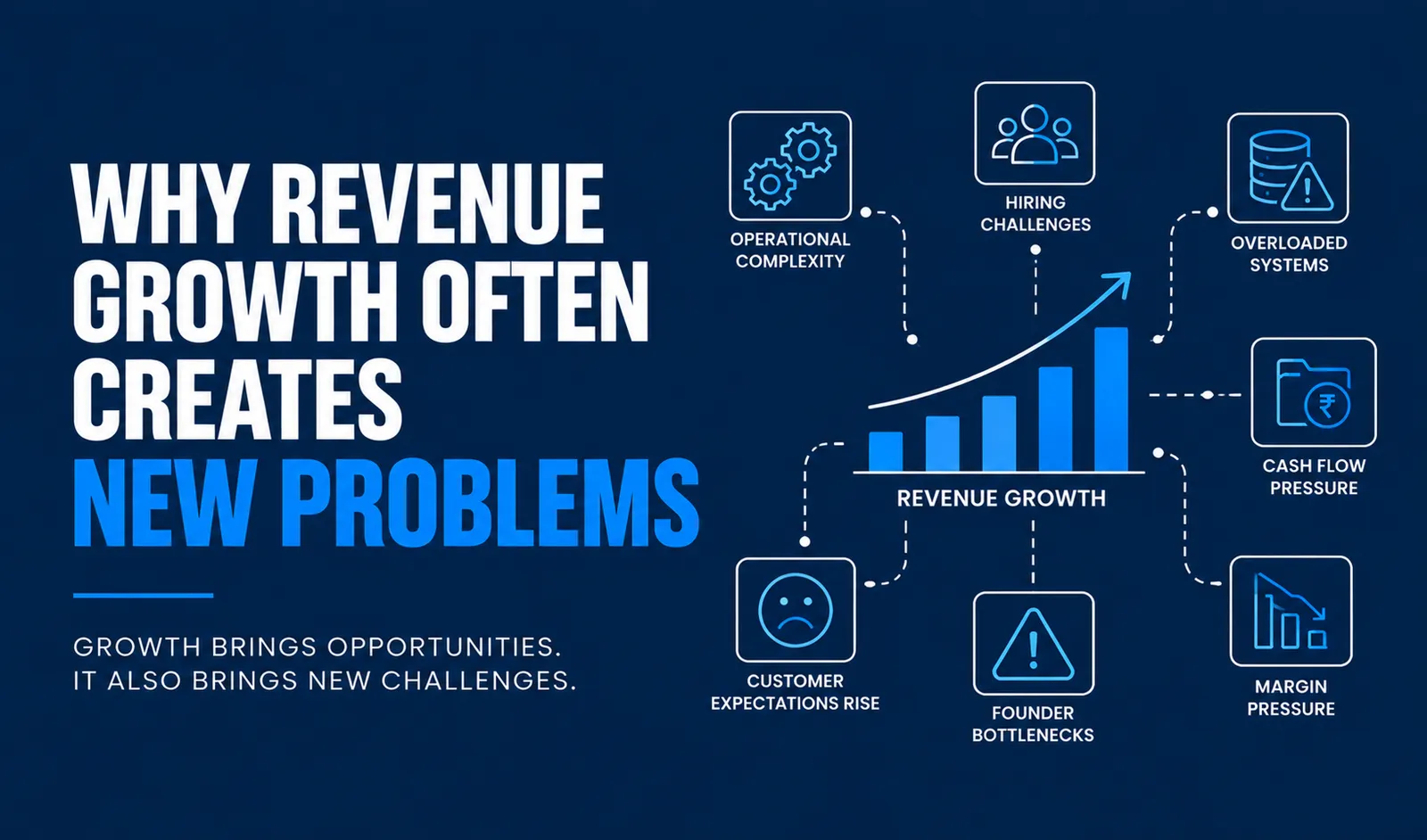
Why Revenue Growth Often Creates New Problems
By the Rytmove Team · 20 Sept 2026
Ask any founder what they want.
Most will answer immediately:
"More revenue."
Revenue growth is often seen as the ultimate measure of success.
Higher sales.
More customers.
Faster growth.
Greater market share.
But experienced founders know something that first-time entrepreneurs often discover the hard way.
Growth solves some problems.
And creates entirely new ones.
Many businesses struggle not because revenue is declining.
They struggle because revenue is growing faster than the organization can handle.
Growth without preparation can create operational, financial, and strategic challenges that threaten long-term success.
The Growth Myth
Founders often imagine growth as a smooth upward journey.
More customers arrive.
Revenue increases.
Profits improve.
The business becomes stronger.
Reality is rarely that simple.
Every growth stage introduces new complexity.
Processes that worked with 100 customers may break at 1,000.
Systems designed for ₹10 lakh monthly revenue may fail at ₹1 crore.
Teams that worked efficiently at a small scale may become bottlenecks as demand increases.
Growth exposes weaknesses that were previously hidden.
Problem #1: Operations Become More Complex
Small businesses often rely on manual processes.
Spreadsheets.
Emails.
Founder oversight.
Direct customer communication.
These systems work at a small scale.
As revenue grows, complexity increases dramatically.
Questions emerge:
Can orders be fulfilled efficiently?
Can customer support handle demand?
Can operations scale without errors?
Can teams maintain quality?
Growth often reveals operational inefficiencies that were invisible earlier.
Problem #2: Customer Expectations Increase
As businesses attract more customers, expectations rise.
Customers expect:
Faster response times
Better support
Consistent quality
Reliable delivery
Improved experiences
A startup may get away with occasional mistakes during its early stages.
Larger customer bases are less forgiving.
As revenue grows, customer experience becomes increasingly important.
Poor service can quickly damage reputation and retention.
Problem #3: Hiring Challenges Accelerate
Growth creates pressure to expand teams.
New hires become necessary across:
Sales
Marketing
Operations
Customer support
Product development
Finance
Unfortunately, hiring at speed often creates new problems.
Businesses may:
Hire the wrong people
Create management layers too early
Develop communication challenges
Increase overhead costs
Scaling teams successfully requires systems, processes, and leadership maturity.
Problem #4: Cash Flow Becomes More Complicated
Many founders assume higher revenue automatically improves financial health.
Often the opposite happens.
Growth frequently requires:
Inventory investments
Hiring costs
Technology expenses
Marketing spend
Infrastructure upgrades
Revenue may increase while cash flow becomes strained.
Businesses can become profitable on paper while facing serious liquidity challenges.
Managing growth requires disciplined financial planning.
Problem #5: Founders Become Bottlenecks
In early-stage businesses, founders make most decisions.
They approve expenses.
Review customer issues.
Manage hiring.
Oversee operations.
This works at a small scale.
As revenue grows, founder dependency becomes a risk.
Decision-making slows.
Teams wait for approvals.
Execution suffers.
Growth often requires founders to shift from doing everything to building systems that operate without them.
Problem #6: Product Complexity Increases
Revenue growth usually brings customer requests.
More customers.
More requirements.
More edge cases.
More feature demands.
Without discipline, businesses begin building for everyone.
The product becomes more complicated.
Roadmaps become crowded.
Innovation slows.
The challenge is balancing customer requests with product focus.
Growth should strengthen the product.
Not dilute it.
Problem #7: Culture Becomes Harder To Maintain
Culture develops naturally in small teams.
People communicate directly.
Everyone understands priorities.
Decision-making remains simple.
As headcount grows, maintaining culture becomes more difficult.
Businesses often experience:
Misalignment
Communication gaps
Reduced accountability
Slower execution
Strong leadership becomes increasingly important during periods of rapid growth.
The Hidden Cost Of Growth
Many founders focus on visible growth metrics:
Revenue
Customers
Transactions
Market share
The hidden metrics are often more important.
Ask:
Is customer satisfaction improving?
Is retention increasing?
Is employee productivity growing?
Are margins healthy?
Is execution becoming easier or harder?
Growth that damages these fundamentals may not be sustainable.
Why Some Companies Struggle After Growth
History is filled with businesses that grew rapidly and then stalled.
Common reasons include:
Poor operational systems
Weak financial controls
Inefficient hiring
Lack of leadership development
Product complexity
Customer experience decline
Growth amplifies strengths.
But it also amplifies weaknesses.
The faster a company grows, the more visible those weaknesses become.
What Experienced Operators Do Differently
Experienced operators prepare for growth before it arrives.
They invest in:
Processes
Systems
Financial discipline
Team development
Customer experience
Leadership capability
They understand that scaling a business is fundamentally different from starting one.
The skills required for ₹10 lakh revenue are often very different from the skills required for ₹10 crore revenue.
Successful operators evolve ahead of growth.
Not after problems emerge.
Questions Every Founder Should Ask During Growth
As revenue increases, founders should regularly ask:
Which processes will break first?
Where are operational bottlenecks emerging?
What decisions still depend on me?
Is customer experience improving?
Can the team handle double the current volume?
Is cash flow keeping pace with growth?
Are we building systems or creating complexity?
The answers often reveal future challenges before they become crises.
Growth Requires More Than Revenue
Revenue growth is important.
But revenue alone is not the goal.
Sustainable businesses grow across multiple dimensions:
Revenue
Profitability
Customer satisfaction
Team capability
Operational excellence
Strategic clarity
The strongest businesses scale all of these together.
Final Thoughts
Revenue growth is exciting.
It validates demand.
Creates opportunities.
Builds momentum.
But growth also creates pressure.
Operational pressure.
Financial pressure.
Leadership pressure.
Execution pressure.
The businesses that thrive are not necessarily the ones that grow the fastest.
They are the ones that prepare for growth before it arrives.
Because growth is not the finish line.
It is the beginning of a completely new set of challenges.
About Rytmove
Business Challenges. Trusted Second Opinions.
Rytmove helps founders, startup teams, SME owners, and business leaders gain clarity on important business decisions through conversations with experienced operators who have solved similar challenges before.
Whether you're managing rapid revenue growth, scaling operations, improving Product Market Fit, reviewing pricing strategy, or planning expansion, Rytmove helps you make better decisions with confidence.
Website: https://rytmove.in