
Blog
Why Smart Businesses Challenge Their Own Assumptions
By the Rytmove Team · 21 Sept 2026
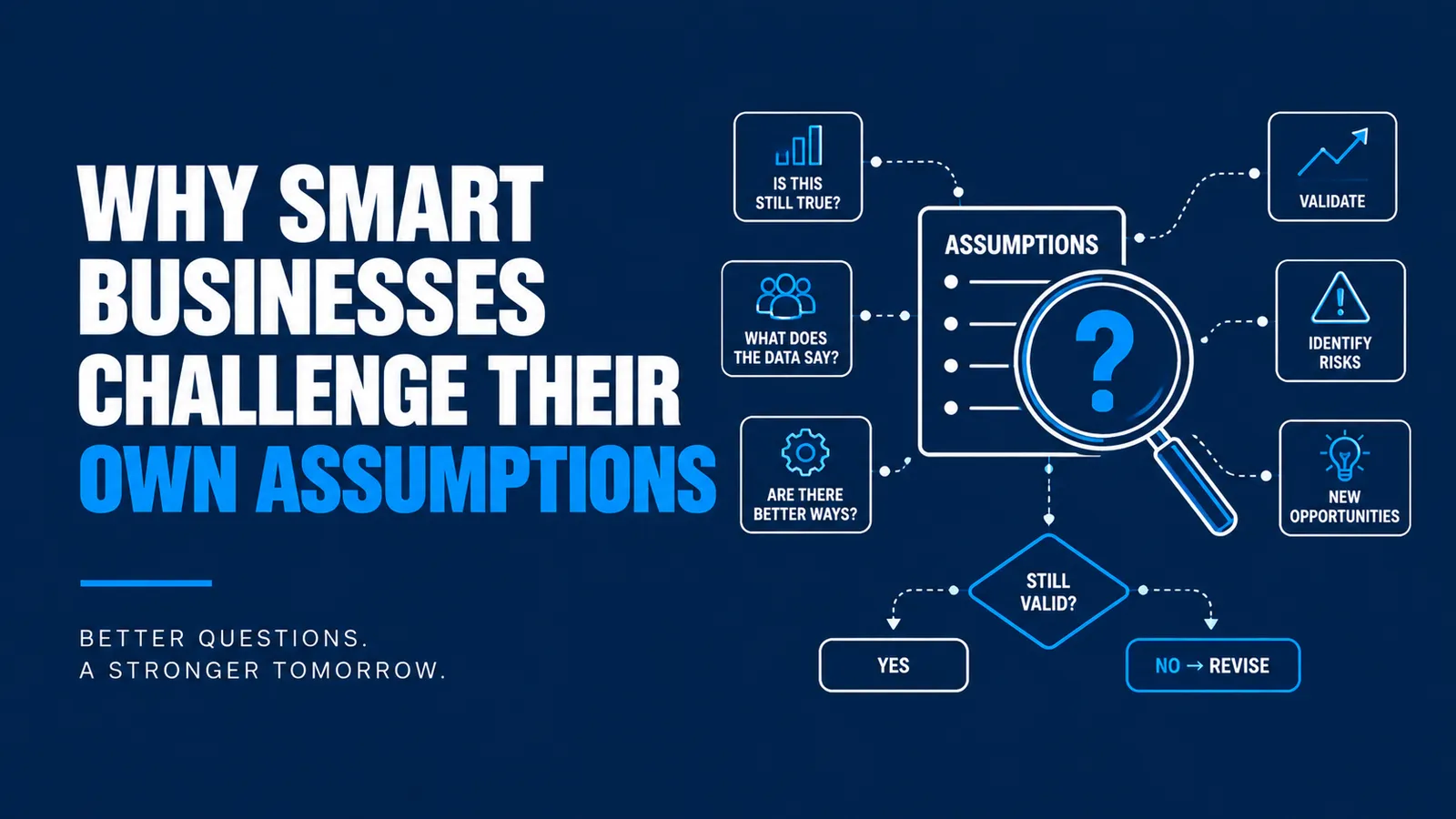
Every business runs on assumptions.
Customers want this product.
The market will continue growing.
Competitors won't react.
Prices can increase.
Demand will remain stable.
The business model will scale.
Some assumptions are correct.
Others are not.
The challenge is that assumptions rarely announce themselves as assumptions.
They often feel like facts.
And that is where problems begin.
Many of the biggest business mistakes are not caused by poor execution.
They are caused by acting on assumptions that were never tested.
The Hidden Risk Of Assumptions
Every strategic decision starts with a belief.
A founder launches a product because they believe customers need it.
A business enters a market because they believe demand exists.
A company hires aggressively because they believe growth will continue.
When assumptions are correct, growth follows.
When assumptions are wrong, businesses often spend months or years moving in the wrong direction.
The cost is rarely visible immediately.
It appears later as:
Slow growth
Poor adoption
Declining profitability
Missed opportunities
Failed initiatives
That is why assumptions deserve scrutiny.
Why Smart Businesses Think Differently
Less experienced businesses often look for confirmation.
Smart businesses look for disconfirmation.
Instead of asking:
"Why will this work?"
They ask:
"What if we're wrong?"
This mindset creates better decisions.
Because finding flaws early is far less expensive than discovering them after execution begins.
Assumption #1: Customers Want What We Built
This is one of the most common assumptions in business.
A product is launched.
Features are added.
Marketing campaigns begin.
Only later does the business discover that customers value something entirely different.
Successful companies validate before scaling.
They ask:
What problem are we solving?
How important is the problem?
Are customers already seeking solutions?
Will customers pay?
Customer validation should happen continuously.
Not just at launch.
Assumption #2: Growth Will Continue Automatically
Early success often creates confidence.
Sometimes too much confidence.
Businesses assume:
Revenue will keep growing
Customer acquisition will remain easy
Demand will stay strong
Competitors will remain behind
History suggests otherwise.
Growth curves rarely continue indefinitely.
Markets evolve.
Customer expectations change.
Competitive pressure increases.
Businesses that challenge growth assumptions adapt faster.
Assumption #3: Price Is The Main Buying Factor
Many businesses believe customers choose primarily based on price.
In reality, buying decisions are often influenced by:
Trust
Convenience
Brand
Reliability
Customer experience
Risk reduction
Lowering prices may increase sales temporarily.
But it may not address the real reasons customers buy.
Smart businesses seek to understand value drivers before changing pricing.
Assumption #4: Competitors Are Not A Threat
Many industries change gradually.
Some change suddenly.
Businesses that underestimate competitors often react too late.
Ask:
What advantages do competitors have?
What could they do better?
How quickly can they adapt?
What new entrants could emerge?
The goal is not fear.
The goal is awareness.
Assumption #5: Internal Opinions Reflect Market Reality
Inside every company, people develop beliefs about customers.
The problem is that internal discussions can become disconnected from reality.
What the team believes.
And what customers believe.
Are not always the same.
The market should always have the final vote.
Data.
Customer conversations.
Retention.
Purchasing behavior.
These provide far more reliable signals than internal opinions.
The Cost Of Confirmation Bias
Confirmation bias affects every business.
People naturally seek information that supports existing beliefs.
And ignore information that challenges them.
This creates risk.
Because evidence against an assumption is often more valuable than evidence supporting it.
Smart leaders actively seek opposing viewpoints.
They ask difficult questions.
They invite disagreement.
They test ideas before fully committing.
How Experienced Operators Challenge Assumptions
Experienced operators rarely assume they have perfect information.
Instead, they continuously test their thinking.
Before making major decisions, they ask:
What assumptions are driving this decision?
What evidence supports them?
What evidence contradicts them?
What would need to be true for this strategy to succeed?
What could cause it to fail?
This process improves decision quality significantly.
A Simple Assumption Audit Framework
Before making a major business decision, list:
Key assumptions
What must be true for success?
Supporting evidence
What data supports those assumptions?
Contradicting evidence
What evidence challenges them?
Validation plan
How can assumptions be tested quickly?
Decision criteria
What results would confirm or invalidate them?
This simple exercise often reveals hidden risks.
Warning Signs Your Assumptions May Be Wrong
Pay attention when:
✗ Customers behave differently than expected
✗ Growth slows unexpectedly
✗ Conversion rates decline
✗ Customer retention weakens
✗ Competitors outperform expectations
✗ Team members avoid difficult questions
✗ Data conflicts with beliefs
These signals often indicate assumptions need re-evaluation.
Why External Perspectives Matter
One reason experienced operators are valuable is that they challenge assumptions others may overlook.
They ask questions that internal teams may stop asking.
They recognize patterns.
They identify blind spots.
They provide perspective gained from solving similar problems before.
Often the most valuable advice is not an answer.
It is a question that changes how a problem is viewed.
Final Thoughts
The smartest businesses are not those that always have the right answers.
They are the ones willing to question their assumptions before reality forces them to.
Markets change.
Customers change.
Business conditions change.
Assumptions should change too.
Because sustainable growth is not built on certainty.
It is built on learning.
And learning begins when assumptions are challenged.
About Rytmove
Business Challenges. Trusted Second Opinions.
Rytmove helps founders, startup teams, SME owners, and business leaders gain clarity on important business decisions through conversations with experienced operators who have solved similar challenges before.
Whether you're evaluating growth opportunities, testing business assumptions, reviewing strategy, assessing investments, or solving complex business challenges, Rytmove helps you make better decisions with confidence.
Website: https://rytmove.in